Applied Regression Analysis and Generalized Linear Models
Third Edition
If you’re in North America, please visit our Sage College Publishing website to purchase or sample this book:
Go to College Publishing WebsiteDescription
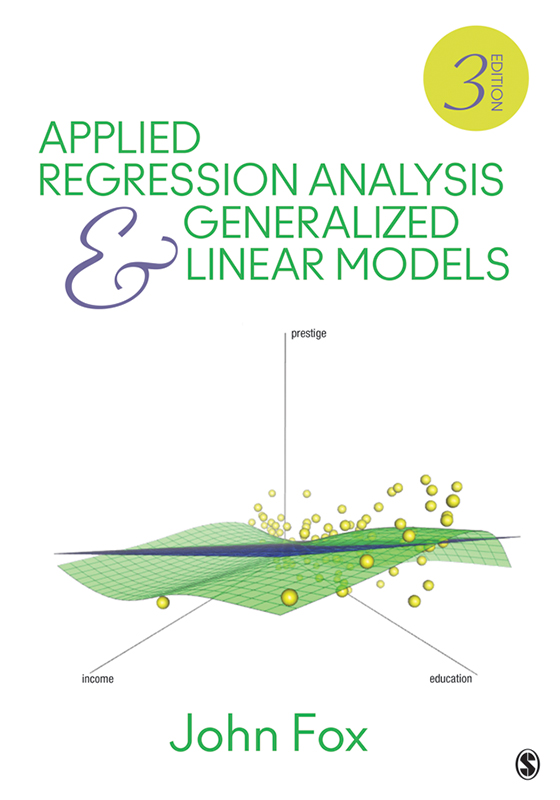
Combining a modern, data-analytic perspective with a focus on applications in the social sciences, the Third Edition of Applied Regression Analysis and Generalized Linear Models provides in-depth coverage of regression analysis, generalized linear models, and closely related methods, such as bootstrapping and missing data. Updated throughout, this Third Edition includes new chapters on mixed-effects models for hierarchical and longitudinal data. Although the text is largely accessible to readers with a modest background in statistics and mathematics, author John Fox also presents more advanced material in optional sections and chapters throughout the book.
Accompanying website resources: An instructor website for the book is available at edge.sagepub.com/fox3e containing all answers to the end-of-chapter exercises. Answers to odd-numbered questions, as well as datasets and other student resources are available on the author's website at: https://www.john-fox.ca/AppliedRegression/index.html.
NEW! Bonus chapters available on the author's website at the URL above!
Chapter 25 on Bayesian Estimation of Regression Models, and
Chapter 26 on Causal Inferences from Observational Data: Directed Acyclic Graphs and Potential Outcomes
Accompanying website resources: An instructor website for the book is available at edge.sagepub.com/fox3e containing all answers to the end-of-chapter exercises. Answers to odd-numbered questions, as well as datasets and other student resources are available on the author's website at: https://www.john-fox.ca/AppliedRegression/index.html.
NEW! Bonus chapters available on the author's website at the URL above!
Chapter 25 on Bayesian Estimation of Regression Models, and
Chapter 26 on Causal Inferences from Observational Data: Directed Acyclic Graphs and Potential Outcomes
Contents
Preface
Preface
About the Author
- 1. Statistical Models and Social Science
- 1.1 Statistical Models and Social Reality
- 1.2 Observation and Experiment
- 1.3 Populations and Samples
I. DATA CRAFT
- 2. What Is Regression Analysis?
- 2.1 Preliminaries
- 2.2 Naive Nonparametric Regression
- 2.3 Local Averaging
- 3. Examining Data
- 3.1 Univariate Displays
- 3.2 Plotting Bivariate Data
- 3.3 Plotting Multivariate Data
- 4. Transforming Data
- 4.1 The Family of Powers and Roots
- 4.2 Transforming Skewness
- 4.3 Transforming Nonlinearity
- 4.4 Transforming Nonconstant Spread
- 4.5 Transforming Proportions
- 4.6 Estimating Transformations as Parameters*
II. LINEAR MODELS AND LEAST SQUARES
- 5. Linear Least-Squares Regression
- 5.1 Simple Regression
- 5.2 Multiple Regression
- 6. Statistical Inference for Regression
- 6.1 Simple Regression
- 6.2 Multiple Regression
- 6.3 Empirical Versus Structural Relations
- 6.4 Measurement Error in Explanatory Variables*
- 7. Dummy-Variable Regression
- 7.1 A Dichotomous Factor
- 7.2 Polytomous Factors
- 7.3 Modeling Interactions
- 8. Analysis of Variance
- 8.1 One-Way Analysis of Variance
- 8.2 Two-Way Analysis of Variance
- 8.3 Higher-Way Analysis of Variance
- 8.4 Analysis of Covariance
- 8.5 Linear Contrasts of Means
- 9. Statistical Theory for Linear Models*
- 9.1 Linear Models in Matrix Form
- 9.2 Least-Squares Fit
- 9.3 Properties of the Least-Squares Estimator
- 9.4 Statistical Inference for Linear Models
- 9.5 Multivariate Linear Models
- 9.6 Random Regressors
- 9.7 Specification Error
- 9.8 Instrumental Variables and Two-Stage Least Squares
- 10. The Vector Geometry of Linear Models*
- 10.1 Simple Regression
- 10.2 Multiple Regression
- 10.3 Estimating the Error Variance
- 10.4 Analysis-of-Variance Models
III. LINEAR-MODEL DIAGNOSTICS
- 11. Unusual and Influential Data
- 11.1 Outliers, Leverage, and Influence
- 11.2 Assessing Leverage: Hat-Values
- 11.3 Detecting Outliers: Studentized Residuals
- 11.4 Measuring Influence
- 11.5 Numerical Cutoffs for Diagnostic Statistics
- 11.6 Joint Influence
- 11.7 Should Unusual Data Be Discarded?
- 11.8 Some Statistical Details*
- 12. Non-Normality, Nonconstant Error Variance, Nonlinearity
- 12.1 Non-Normally Distributed Errors
- 12.2 Nonconstant Error Variance
- 12.3 Nonlinearity
- 12.4 Discrete Data
- 12.5 Maximum-Likelihood Methods*
- 12.6 Structural Dimension
- 13. Collinearity and Its Purported Remedies
- 13.1 Detecting Collinearity
- 13.2 Coping With Collinearity: No Quick Fix
IV. GENERALIZED LINEAR MODELS
- 14. Logit and Probit Models for Categorical Response Variables
- 14.1 Models for Dichotomous Data
- 14.2 Models for Polytomous Data
- 14.3 Discrete Explanatory Variables and Contingency Tables
- 15. Generalized Linear Models
- 15.1 The Structure of Generalized Linear Models
- 15.2 Generalized Linear Models for Counts
- 15.3 Statistical Theory for Generalized Linear Models*
- 15.4 Diagnostics for Generalized Linear Models
- 15.5 Analyzing Data From Complex Sample Surveys
V. EXTENDING LINEAR AND GENERALIZED LINEAR MODELS
- 16. Time-Series Regression and Generalized Leasr Squares*
- 16.1 Generalized Least-Squares Estimation
- 16.2 Serially Correlated Errors
- 16.3 GLS Estimation With Autocorrelated Errors
- 16.4 Correcting OLS Inference for Autocorrelated Errors
- 16.5 Diagnosing Serially Correlated Errors
- 16.6 Concluding Remarks
- 17. Nonlinear Regression
- 17.1 Polynomial Regression
- 17.2 Piece-wise Polynomials and Regression Splines
- 17.3 Transformable Nonlinearity
- 17.4 Nonlinear Least Squares*
- 18. Nonparametric Regression
- 18.1 Nonparametric Simple Regression: Scatterplot Smoothing
- 18.2 Nonparametric Multiple Regression
- 18.3 Generalized Nonparametric Regression
- 19. Robust Regression*
- 19.1 M Estimation
- 19.2 Bounded-Influence Regression
- 19.3 Quantile Regression
- 19.4 Robust Estimation of Generalized Linear Models
- 19.5 Concluding Remarks
- 20. Missing Data in Regression Models
- 20.1 Missing Data Basics
- 20.2 Traditional Approaches to Missing Data
- 20.3 Maximum-Likelihood Estimation for Data Missing at Random*
- 20.4 Bayesian Multiple Imputation
- 20.5 Selection Bias and Censoring
- 21. Bootstrapping Regression Models
- 21.1 Bootstrapping Basics
- 21.2 Bootstrap Confidence Intervals
- 21.3 Bootstrapping Regression Models
- 21.4 Bootstrap Hypothesis Tests*
- 21.5 Bootstrapping Complex Sampling Designs
- 21.6 Concluding Remarks
- 22. Model Selection, Averaging, and Validation
- 22.1 Model Selection
- 22.2 Model Averaging*
- 22.3 Model Validation
VI. MIXED-EFFECT MODELS
- 23. Linear Mixed-Effects Models for Hierarchical and Longitudinal Data
- 23.1 Hierarchical and Longitudinal Data
- 23.2 The Linear Mixed-Effects Model
- 23.3 Modeling Hierarchical Data
- 23.4 Modeling Longitudinal Data
- 23.5 Wald Tests for Fixed Effects
- 23.6 Likelihood-Ratio Tests of Variance and Covariance Components
- 23.7 Centering Explanatory Variables, Contextual Effects, and Fixed-Effects Models
- 23.8 BLUPs
- 23.9 Statistical Details*
- 24. Generalized Linear and Nonlinear Mixed-Effects Models
- 24.1 Generalized Linear Mixed Models
- 24.2 Nonlinear Mixed Models
Appendix A
Appendix A
References
References
Author Index
Author Index
Subject Index
Subject Index
Data Set Index
Data Set Index
Additional materials
Description
Combining a modern, data-analytic perspective with a focus on applications in the social sciences, the Third Edition of Applied Regression Analysis and Generalized Linear Models provides in-depth coverage of regression analysis, generalized linear models, and closely related methods, such as bootstrapping and missing data. Updated throughout, this Third Edition includes new chapters on mixed-effects models for hierarchical and longitudinal data. Although the text is largely accessible to readers with a modest background in statistics and mathematics, author John Fox also presents more advanced material in optional sections and chapters throughout the book.
Accompanying website resources: An instructor website for the book is available at edge.sagepub.com/fox3e containing all answers to the end-of-chapter exercises. Answers to odd-numbered questions, as well as datasets and other student resources are available on the author's website at: https://www.john-fox.ca/AppliedRegression/index.html.
NEW! Bonus chapters available on the author's website at the URL above!
Chapter 25 on Bayesian Estimation of Regression Models, and
Chapter 26 on Causal Inferences from Observational Data: Directed Acyclic Graphs and Potential Outcomes
Accompanying website resources: An instructor website for the book is available at edge.sagepub.com/fox3e containing all answers to the end-of-chapter exercises. Answers to odd-numbered questions, as well as datasets and other student resources are available on the author's website at: https://www.john-fox.ca/AppliedRegression/index.html.
NEW! Bonus chapters available on the author's website at the URL above!
Chapter 25 on Bayesian Estimation of Regression Models, and
Chapter 26 on Causal Inferences from Observational Data: Directed Acyclic Graphs and Potential Outcomes
Contents
Preface
Preface
About the Author
- 1. Statistical Models and Social Science
- 1.1 Statistical Models and Social Reality
- 1.2 Observation and Experiment
- 1.3 Populations and Samples
I. DATA CRAFT
- 2. What Is Regression Analysis?
- 2.1 Preliminaries
- 2.2 Naive Nonparametric Regression
- 2.3 Local Averaging
- 3. Examining Data
- 3.1 Univariate Displays
- 3.2 Plotting Bivariate Data
- 3.3 Plotting Multivariate Data
- 4. Transforming Data
- 4.1 The Family of Powers and Roots
- 4.2 Transforming Skewness
- 4.3 Transforming Nonlinearity
- 4.4 Transforming Nonconstant Spread
- 4.5 Transforming Proportions
- 4.6 Estimating Transformations as Parameters*
II. LINEAR MODELS AND LEAST SQUARES
- 5. Linear Least-Squares Regression
- 5.1 Simple Regression
- 5.2 Multiple Regression
- 6. Statistical Inference for Regression
- 6.1 Simple Regression
- 6.2 Multiple Regression
- 6.3 Empirical Versus Structural Relations
- 6.4 Measurement Error in Explanatory Variables*
- 7. Dummy-Variable Regression
- 7.1 A Dichotomous Factor
- 7.2 Polytomous Factors
- 7.3 Modeling Interactions
- 8. Analysis of Variance
- 8.1 One-Way Analysis of Variance
- 8.2 Two-Way Analysis of Variance
- 8.3 Higher-Way Analysis of Variance
- 8.4 Analysis of Covariance
- 8.5 Linear Contrasts of Means
- 9. Statistical Theory for Linear Models*
- 9.1 Linear Models in Matrix Form
- 9.2 Least-Squares Fit
- 9.3 Properties of the Least-Squares Estimator
- 9.4 Statistical Inference for Linear Models
- 9.5 Multivariate Linear Models
- 9.6 Random Regressors
- 9.7 Specification Error
- 9.8 Instrumental Variables and Two-Stage Least Squares
- 10. The Vector Geometry of Linear Models*
- 10.1 Simple Regression
- 10.2 Multiple Regression
- 10.3 Estimating the Error Variance
- 10.4 Analysis-of-Variance Models
III. LINEAR-MODEL DIAGNOSTICS
- 11. Unusual and Influential Data
- 11.1 Outliers, Leverage, and Influence
- 11.2 Assessing Leverage: Hat-Values
- 11.3 Detecting Outliers: Studentized Residuals
- 11.4 Measuring Influence
- 11.5 Numerical Cutoffs for Diagnostic Statistics
- 11.6 Joint Influence
- 11.7 Should Unusual Data Be Discarded?
- 11.8 Some Statistical Details*
- 12. Non-Normality, Nonconstant Error Variance, Nonlinearity
- 12.1 Non-Normally Distributed Errors
- 12.2 Nonconstant Error Variance
- 12.3 Nonlinearity
- 12.4 Discrete Data
- 12.5 Maximum-Likelihood Methods*
- 12.6 Structural Dimension
- 13. Collinearity and Its Purported Remedies
- 13.1 Detecting Collinearity
- 13.2 Coping With Collinearity: No Quick Fix
IV. GENERALIZED LINEAR MODELS
- 14. Logit and Probit Models for Categorical Response Variables
- 14.1 Models for Dichotomous Data
- 14.2 Models for Polytomous Data
- 14.3 Discrete Explanatory Variables and Contingency Tables
- 15. Generalized Linear Models
- 15.1 The Structure of Generalized Linear Models
- 15.2 Generalized Linear Models for Counts
- 15.3 Statistical Theory for Generalized Linear Models*
- 15.4 Diagnostics for Generalized Linear Models
- 15.5 Analyzing Data From Complex Sample Surveys
V. EXTENDING LINEAR AND GENERALIZED LINEAR MODELS
- 16. Time-Series Regression and Generalized Leasr Squares*
- 16.1 Generalized Least-Squares Estimation
- 16.2 Serially Correlated Errors
- 16.3 GLS Estimation With Autocorrelated Errors
- 16.4 Correcting OLS Inference for Autocorrelated Errors
- 16.5 Diagnosing Serially Correlated Errors
- 16.6 Concluding Remarks
- 17. Nonlinear Regression
- 17.1 Polynomial Regression
- 17.2 Piece-wise Polynomials and Regression Splines
- 17.3 Transformable Nonlinearity
- 17.4 Nonlinear Least Squares*
- 18. Nonparametric Regression
- 18.1 Nonparametric Simple Regression: Scatterplot Smoothing
- 18.2 Nonparametric Multiple Regression
- 18.3 Generalized Nonparametric Regression
- 19. Robust Regression*
- 19.1 M Estimation
- 19.2 Bounded-Influence Regression
- 19.3 Quantile Regression
- 19.4 Robust Estimation of Generalized Linear Models
- 19.5 Concluding Remarks
- 20. Missing Data in Regression Models
- 20.1 Missing Data Basics
- 20.2 Traditional Approaches to Missing Data
- 20.3 Maximum-Likelihood Estimation for Data Missing at Random*
- 20.4 Bayesian Multiple Imputation
- 20.5 Selection Bias and Censoring
- 21. Bootstrapping Regression Models
- 21.1 Bootstrapping Basics
- 21.2 Bootstrap Confidence Intervals
- 21.3 Bootstrapping Regression Models
- 21.4 Bootstrap Hypothesis Tests*
- 21.5 Bootstrapping Complex Sampling Designs
- 21.6 Concluding Remarks
- 22. Model Selection, Averaging, and Validation
- 22.1 Model Selection
- 22.2 Model Averaging*
- 22.3 Model Validation
VI. MIXED-EFFECT MODELS
- 23. Linear Mixed-Effects Models for Hierarchical and Longitudinal Data
- 23.1 Hierarchical and Longitudinal Data
- 23.2 The Linear Mixed-Effects Model
- 23.3 Modeling Hierarchical Data
- 23.4 Modeling Longitudinal Data
- 23.5 Wald Tests for Fixed Effects
- 23.6 Likelihood-Ratio Tests of Variance and Covariance Components
- 23.7 Centering Explanatory Variables, Contextual Effects, and Fixed-Effects Models
- 23.8 BLUPs
- 23.9 Statistical Details*
- 24. Generalized Linear and Nonlinear Mixed-Effects Models
- 24.1 Generalized Linear Mixed Models
- 24.2 Nonlinear Mixed Models
Appendix A
Appendix A
References
References
Author Index
Author Index
Subject Index
Subject Index
Data Set Index
Data Set Index
Additional materials
Reviews

April 2015 | 816 pages | Sage US
| Format | Published Date | ISBN | Price |
|---|
Combining a modern, data-analytic perspective with a focus on applications in the social sciences, the Third Edition of Applied Regression Analysis and Generalized Linear Models provides in-depth coverage of regression analysis, generalized linear models, and closely related methods, such as bootstrapping and missing data. Updated throughout, this Third Edition includes new chapters on mixed-effects models for hierarchical and longitudinal data. Although the text is largely accessible to readers with a modest background in statistics and mathematics, author John Fox also presents more advanced material in optional sections and chapters throughout the book.
Accompanying website resources: An instructor website for the book is available at edge.sagepub.com/fox3e containing all answers to the end-of-chapter exercises. Answers to odd-numbered questions, as well as datasets and other student resources are available on the author's website at: https://www.john-fox.ca/AppliedRegression/index.html.
NEW! Bonus chapters available on the author's website at the URL above!
Chapter 25 on Bayesian Estimation of Regression Models, and
Chapter 26 on Causal Inferences from Observational Data: Directed Acyclic Graphs and Potential Outcomes
Accompanying website resources: An instructor website for the book is available at edge.sagepub.com/fox3e containing all answers to the end-of-chapter exercises. Answers to odd-numbered questions, as well as datasets and other student resources are available on the author's website at: https://www.john-fox.ca/AppliedRegression/index.html.
NEW! Bonus chapters available on the author's website at the URL above!
Chapter 25 on Bayesian Estimation of Regression Models, and
Chapter 26 on Causal Inferences from Observational Data: Directed Acyclic Graphs and Potential Outcomes
Table Of Contents:
- Preface
- About the Author
- 1. Statistical Models and Social Science
- 1.1 Statistical Models and Social Reality
- 1.2 Observation and Experiment
- 1.3 Populations and Samples
- I. DATA CRAFT
- 2. What Is Regression Analysis?
- 2.1 Preliminaries
- 2.2 Naive Nonparametric Regression
- 2.3 Local Averaging
- 3. Examining Data
- 3.1 Univariate Displays
- 3.2 Plotting Bivariate Data
- 3.3 Plotting Multivariate Data
- 4. Transforming Data
- 4.1 The Family of Powers and Roots
- 4.2 Transforming Skewness
- 4.3 Transforming Nonlinearity
- 4.4 Transforming Nonconstant Spread
- 4.5 Transforming Proportions
- 4.6 Estimating Transformations as Parameters*
- II. LINEAR MODELS AND LEAST SQUARES
- 5. Linear Least-Squares Regression
- 5.1 Simple Regression
- 5.2 Multiple Regression
- 6. Statistical Inference for Regression
- 6.1 Simple Regression
- 6.2 Multiple Regression
- 6.3 Empirical Versus Structural Relations
- 6.4 Measurement Error in Explanatory Variables*
- 7. Dummy-Variable Regression
- 7.1 A Dichotomous Factor
- 7.2 Polytomous Factors
- 7.3 Modeling Interactions
- 8. Analysis of Variance
- 8.1 One-Way Analysis of Variance
- 8.2 Two-Way Analysis of Variance
- 8.3 Higher-Way Analysis of Variance
- 8.4 Analysis of Covariance
- 8.5 Linear Contrasts of Means
- 9. Statistical Theory for Linear Models*
- 9.1 Linear Models in Matrix Form
- 9.2 Least-Squares Fit
- 9.3 Properties of the Least-Squares Estimator
- 9.4 Statistical Inference for Linear Models
- 9.5 Multivariate Linear Models
- 9.6 Random Regressors
- 9.7 Specification Error
- 9.8 Instrumental Variables and Two-Stage Least Squares
- 10. The Vector Geometry of Linear Models*
- 10.1 Simple Regression
- 10.2 Multiple Regression
- 10.3 Estimating the Error Variance
- 10.4 Analysis-of-Variance Models
- III. LINEAR-MODEL DIAGNOSTICS
- 11. Unusual and Influential Data
- 11.1 Outliers, Leverage, and Influence
- 11.2 Assessing Leverage: Hat-Values
- 11.3 Detecting Outliers: Studentized Residuals
- 11.4 Measuring Influence
- 11.5 Numerical Cutoffs for Diagnostic Statistics
- 11.6 Joint Influence
- 11.7 Should Unusual Data Be Discarded?
- 11.8 Some Statistical Details*
- 12. Non-Normality, Nonconstant Error Variance, Nonlinearity
- 12.1 Non-Normally Distributed Errors
- 12.2 Nonconstant Error Variance
- 12.3 Nonlinearity
- 12.4 Discrete Data
- 12.5 Maximum-Likelihood Methods*
- 12.6 Structural Dimension
- 13. Collinearity and Its Purported Remedies
- 13.1 Detecting Collinearity
- 13.2 Coping With Collinearity: No Quick Fix
- IV. GENERALIZED LINEAR MODELS
- 14. Logit and Probit Models for Categorical Response Variables
- 14.1 Models for Dichotomous Data
- 14.2 Models for Polytomous Data
- 14.3 Discrete Explanatory Variables and Contingency Tables
- 15. Generalized Linear Models
- 15.1 The Structure of Generalized Linear Models
- 15.2 Generalized Linear Models for Counts
- 15.3 Statistical Theory for Generalized Linear Models*
- 15.4 Diagnostics for Generalized Linear Models
- 15.5 Analyzing Data From Complex Sample Surveys
- V. EXTENDING LINEAR AND GENERALIZED LINEAR MODELS
- 16. Time-Series Regression and Generalized Leasr Squares*
- 16.1 Generalized Least-Squares Estimation
- 16.2 Serially Correlated Errors
- 16.3 GLS Estimation With Autocorrelated Errors
- 16.4 Correcting OLS Inference for Autocorrelated Errors
- 16.5 Diagnosing Serially Correlated Errors
- 16.6 Concluding Remarks
- 17. Nonlinear Regression
- 17.1 Polynomial Regression
- 17.2 Piece-wise Polynomials and Regression Splines
- 17.3 Transformable Nonlinearity
- 17.4 Nonlinear Least Squares*
- 18. Nonparametric Regression
- 18.1 Nonparametric Simple Regression: Scatterplot Smoothing
- 18.2 Nonparametric Multiple Regression
- 18.3 Generalized Nonparametric Regression
- 19. Robust Regression*
- 19.1 M Estimation
- 19.2 Bounded-Influence Regression
- 19.3 Quantile Regression
- 19.4 Robust Estimation of Generalized Linear Models
- 19.5 Concluding Remarks
- 20. Missing Data in Regression Models
- 20.1 Missing Data Basics
- 20.2 Traditional Approaches to Missing Data
- 20.3 Maximum-Likelihood Estimation for Data Missing at Random*
- 20.4 Bayesian Multiple Imputation
- 20.5 Selection Bias and Censoring
- 21. Bootstrapping Regression Models
- 21.1 Bootstrapping Basics
- 21.2 Bootstrap Confidence Intervals
- 21.3 Bootstrapping Regression Models
- 21.4 Bootstrap Hypothesis Tests*
- 21.5 Bootstrapping Complex Sampling Designs
- 21.6 Concluding Remarks
- 22. Model Selection, Averaging, and Validation
- 22.1 Model Selection
- 22.2 Model Averaging*
- 22.3 Model Validation
- VI. MIXED-EFFECT MODELS
- 23. Linear Mixed-Effects Models for Hierarchical and Longitudinal Data
- 23.1 Hierarchical and Longitudinal Data
- 23.2 The Linear Mixed-Effects Model
- 23.3 Modeling Hierarchical Data
- 23.4 Modeling Longitudinal Data
- 23.5 Wald Tests for Fixed Effects
- 23.6 Likelihood-Ratio Tests of Variance and Covariance Components
- 23.7 Centering Explanatory Variables, Contextual Effects, and Fixed-Effects Models
- 23.8 BLUPs
- 23.9 Statistical Details*
- 24. Generalized Linear and Nonlinear Mixed-Effects Models
- 24.1 Generalized Linear Mixed Models
- 24.2 Nonlinear Mixed Models
- Appendix A
- References
- Author Index
- Subject Index
- Data Set Index
Recent Product Reviews:
The strength of this text is the unified presentation of several regression topics that provides the student with a global perspective on regression analysis. The student is well served with this unified approach as it facilitates deeper research on any one topic with more advanced texts.
E. C. Hedberg, Arizona State University
This text is a one-stop shop for me for my first year stats sequence for students in our program. Those wanting the technical detail will be satisfied; those wanting an excellent explanation of these methods using real-world examples and approachable language will also be satisfied.
Corey S. Sparks, The University of Texas at San Antonio
I have enjoyed using previous editions of this text and look forward to using this edition. It covers all key topics, and quite a few advanced ones, in one well-written text.
Michael S. Lynch, University of Georgia
PRAISE FOR THE PREVIOUS EDITIONS In summary, this is an excellent text on regression applications and methods, written with authority, lucidity, and eloquence. The second edition provides substantive and topical updates, and makes the book suitable for courses designed to emphasize both the classical and the modern aspects of regression.
Journal of the American Statistical Association (review of the second edition)
PRAISE FOR THE PREVIOUS EDITIONS Even though the book is written with social scientists as the target audience, the depth of material and how it is conveyed give it far broader appeal. Indeed, I recommend it as a useful learning text and resource for researchers and students in any field that applies regression or linear models (that is, most everyone), including courses for undergraduate statistics majors…. The author is to be commended for giving us this book, which I trust will find a wide and enduring readership.
Journal of the American Statistical Association (review of the first edition)