Applied Statistics II
If you’re in North America, please visit our Sage College Publishing website to purchase or sample this book:
Go to College Publishing WebsiteDescription
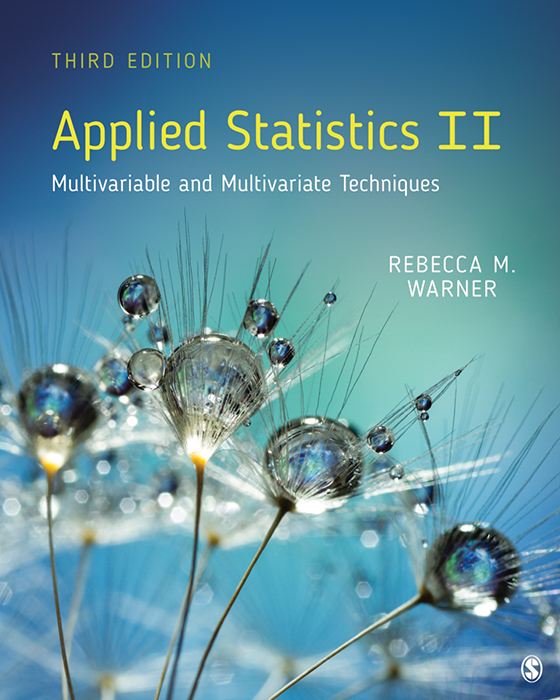
Rebecca M. Warner’s bestselling Applied Statistics: From Bivariate Through Multivariate Techniques has been split into two volumes for ease of use over a two-course sequence. Applied Statistics II: Multivariable and Multivariate Techniques, Third Edition is a core multivariate statistics text based on chapters from the second half of the original book.
The text begins with two new chapters: an introduction to the new statistics, and a chapter on handling outliers and missing values. All chapters on statistical control and multivariable or multivariate analyses from the previous edition are retained (with the moderation chapter heavily revised) and new chapters have been added on structural equation modeling, repeated measures, and on additional statistical techniques. Each chapter includes a complete example, and begins by considering the types of research questions that chapter’s technique can answer, progresses to data screening, and provides screen shots of SPSS menu selections and output, and concludes with sample results sections. By-hand computation is used, where possible, to show how elements of the output are related to each other, and to obtain confidence interval and effect size information when SPSS does not provide this. Datasets are available on the accompanying website.
Bundle and Save
Applied Statistics II + Applied Statistics I: Basic Bivariate Techniques, Third Edition
Bundle Volume I and II ISBN: 978-1-0718-1337-9
An R Companion for Applied Statistics II: Multivariable and Multivariate Techniques + Applied Statistics II
Bundle ISBN: 978-1-0718-3618-7
Contents
Preface
Preface
Acknowledgments
Acknowledgments
About the Author
- 1. The New Statistics
- Required Background
- What Is the “New Statistics”?
- Common Misinterpretations of p Values
- Problems With NHST Logic
- Common Misuses of NHST
- The Replication Crisis
- Some Proposed Remedies for Problems With NHST
- Review of Confidence Intervals
- Effect Size
- Brief Introduction to Meta-Analysis
- Recommendations for Better Research and Analysis
- Summary
- 2. Advanced Data Screening: Outliers and Missing Values
- Introduction
- Variable Names and File Management
- Sources of Bias
- Screening Sample Data
- Possible Remedy for Skewness: Nonlinear Data Transformations
- Identification of Outliers
- Handling Outliers
- Testing Linearity Assumptions
- Evaluation of Other Assumptions Specific to Analyses
- Describing Amount of Missing Data
- How Missing Data Arise
- Patterns in Missing Data
- Empirical Example: Detecting Type a Missingness
- Possible Remedies for Missing Data
- Empirical Example: Multiple Imputation to Replace Missing Values
- Data Screening Checklist
- Reporting Guidelines
- Summary
- Appendix 2A: Brief Note About Zero-Inflated Binomial or Poisson Regression
- 3. Statistical Control: What Can Happen When You Add a Third Variable?
- What Is Statistical Control?
- First Research Example: Controlling for a Categorical X2 Variable
- Assumptions for Partial Correlation Between X1 and Y, Controlling for X2
- Notation for Partial Correlation
- Understanding Partial Correlation: Use of Bivariate Regressions to Remove Variance Predictable by X2 From Both X1 and Y
- Partial Correlation Makes No Sense if There Is an X1 × X2 Interaction
- Computation of Partial r From Bivariate Pearson Correlations
- Significance Tests, Confidence Intervals, and Statistical Power for Partial Correlations
- Comparing Outcomes for ry1.2 and ry1
- Introduction to Path Models
- Possible Paths Among X1, Y, and X2
- One Possible Model: X1 and Y are Not Related Whether You Control for X2 or Not
- Possible Model: Correlation Between X1 and Y is the Same Whether X2 Is Statistically Controlled or Not (X2 is Irrelevant to the X1, Y Relationship)
- When You Control for X2, Correlation Between X1 and Y Drops to Zero
- When You Control for X2, the Correlation Between X1 and Y Becomes Smaller (But Does not Drop to 0 or Change Sign)
- Some Forms of Suppression: When You Control for X2, r1y.2 Becomes Larger Than r1y or Opposite in Sign to r1y
- “None of the Above”
- Results Section
- Summary
- 4. Regression Analysis and Statistical Control
- Introduction
- Hypothetical Research Example
- Graphic Representation of Regression Plane
- Semipartial (or “Part”) Correlation
- Partition of Variance In Y in Regression With Two Predictors
- Assumptions for Regression With Two Predictors
- Formulas for Regression With Two Predictors
- SPSS Regression
- Conceptual Basis: Factors That Affect the Magnitude and Sign of ß and b Coefficients in Multiple Regression With Two Predictors
- Tracing Rules for Path Models
- Comparison of Equations for ß, b, pr, and sr
- Nature of Predictive Relationships
- Effect Size Information in Regression with Two Predictors
- Statistical Power
- Issues in Planning a Study
- Results
- Summary
- 5. Multiple Regression With Multiple Predictors
- Research Questions
- Empirical Example
- Screening for Violations of Assumptions
- Issues in Planning a Study
- Computation of Regression Coefficients with k Predictor Variables
- Methods of Entry for Predictor Variables
- Variance Partitioning in Standard Regression Versus Hierarchical and Statistical Regression
- Significance Test for an Overall Regression Model
- Significance Tests for Individual Predictors in Multiple Regression
- Effect Size
- Changes in F and R as Additional Predictors Are Added to a Model in Sequential or Statistical Regression
- Statistical Power
- Nature of the Relationship Between Each X Predictor and Y (Controlling for Other Predictors)
- Assessment of Multivariate Outliers in Regression
- SPSS Examples
- Summary
- Appendix 5A: Use of Matrix Algebra to Estimate Regression Coefficients for Multiple Predictors
- Appendix 5B: Tables for Wilkinson and Dallal (1981) Test of Significance of Multiple R2 in Forward Statistical Regression
- Appendix 5C: Confidence Interval for R2
- 6. Dummy Predictor Variables in Multiple Regression
- What Dummy Variables Are and When They Are Used
- Empirical Example
- Screening for Violations of Assumptions
- Issues in Planning a Study
- Parameter Estimates and Significance Tests for Regressions With Dummy Predictor Variables
- Group Mean Comparisons Using One-Way Between-S ANOVA
- Three Methods of Coding for Dummy Variables
- Regression Models That Include Both Dummy and Quantitative Predictor Variables
- Effect Size and Statistical Power
- Nature of the Relationship and/or Follow-Up Tests
- Results
- Summary
- 7. Moderation: Interaction in Multiple Regression
- Terminology
- Interaction Between Two Categorical Predictors: Factorial ANOVA
- Interaction Between One Categorical and One Quantitative Predictor
- Preliminary Data Screening: One Categorical and One Quantitative Predictor
- Scatterplot for Preliminary Assessment of Possible Interaction Between Categorical and Quantitative Predictor
- Regression to Assess Statistical Significance of Interaction Between One Categorical and One Quantitative Predictor
- Interaction Analysis With More Than Three Categories
- Example With Different Data: Significant Sex-by-Years Interaction
- Follow-Up: Analysis of Simple Main Effects
- Interaction Between Two Quantitative Predictors
- SPSS Example of Interaction Between Two Quantitative Predictors
- Results for Interaction of Age and Habits as Predictors of Symptoms
- Graphing Interaction for Two Quantitative Predictors
- Results Section for Interaction of Two Quantitative Predictors
- Additional Issues and Summary
- Appendix 7A: Graphing Interactions Between Quantitative Variables “by Hand”
- 8. Analysis of Covariance
- Research Situations for Analysis of Covariance
- Empirical Example
- Screening for Violations of Assumptions
- Variance Partitioning in ANCOVA
- Issues in Planning a Study
- Formulas for ANCOVA
- Computation of Adjusted Effects and Adjusted Y * Means
- Conceptual Basis: Factors That Affect the Magnitude of SSAadj and SSresidual and the Pattern of Adjusted Group Means
- Effect Size
- Statistical Power
- Nature of the Relationship and Follow-Up Tests: Information to Include in the “Results” Section
- SPSS Analysis and Model Results
- Additional Discussion of ANCOVA Results
- Summary
- Appendix 8A: Alternative Methods for the Analysis of Pretest–Posttest Data
- 9. Mediation
- Definition of Mediation
- Hypothetical Research Example
- Limitations of “Causal” Models
- Questions in a Mediation Analysis
- Issues in Designing a Mediation Analysis Study
- Assumptions in Mediation Analysis and Preliminary Data Screening
- Path Coefficient Estimation
- Conceptual Issues: Assessment of Direct Versus Indirect Paths
- Evaluating Statistical Significance
- Effect Size Information
- Sample Size and Statistical Power
- Additional Examples of Mediation Models
- Note About Use of Structural Equation Modeling Programs to Test Mediation Models
- Results Section
- Summary
- 10. Discriminant Analysis
- Research Situations and Research Questions
- Introduction to Empirical Example
- Screening for Violations of Assumptions
- Issues in Planning a Study
- Equations for Discriminant Analysis
- Conceptual Basis: Factors That Affect the Magnitude of Wilks’ Lambda
- Effect Size
- Statistical Power and Sample Size Recommendations
- Follow-Up Tests to Assess What Pattern of Scores Best Differentiates Groups
- Results
- One-Way ANOVA on Scores on Discriminant Functions
- Summary
- Appendix 10A: The Eigenvalue/Eigenvector Problem
- Appendix 10B: Additional Equations for Discriminant Analysis
- 11. Multivariate Analysis of Variance
- Research Situations and Research Questions
- First Research Example: One-Way MANOVA
- Why Include Multiple Outcome Measures?
- Equivalence of MANOVA and DA
- The General Linear Model
- Assumptions and Data Screening
- Issues in Planning a Study
- Conceptual Basis of MANOVA
- Multivariate Test Statistics
- Factors That Influence the Magnitude of Wilks’ Lambda
- Effect Size for MANOVA
- Statistical Power and Sample Size Decisions
- One-Way MANOVA: Career Group Data
- 2 × 3 Factorial MANOVA: Career Group Data
- Significant Interaction in a 3 × 6 MANOVA
- Comparison of Univariate and Multivariate Follow-Up Analyses
- Summary
- 12. Exploratory Factor Analysis
- Research Situations
- Path Model for Factor Analysis
- Factor Analysis as a Method of Data Reduction
- Introduction of Empirical Example
- Screening for Violations of Assumptions
- Issues in Planning a Factor-Analytic Study
- Computation of Factor Loadings
- Steps in the Computation of PC and Factor Analysis
- Analysis 1: PC Analysis of Three Items Retaining All Three Components
- Analysis 2: PC Analysis of Three Items Retaining Only the First Component
- PC Versus PAF
- Analysis 3: PAF of Nine Items, Two Factors Retained, No Rotation
- Geometric Representation of Factor Rotation
- Factor Analysis as Two Sets of Multiple Regressions
- Analysis 4: PAF With Varimax Rotation
- Questions to Address in the Interpretation of Factor Analysis
- Results Section for Analysis 4: PAF With Varimax Rotation
- Factor Scores Versus Unit-Weighted Composites
- Summary of Issues in Factor Analysis
- Appendix 12A: The Matrix Algebra of Factor Analysis
- Appendix 12B: A Brief Introduction to Latent Variables in SEM
- 13. Reliability, Validity, and Multiple-Item Scales
- Assessment of Measurement Quality
- Cost and Invasiveness of Measurements
- Empirical Examples of Reliability Assessment
- Concepts from Classical Measurement Theory
- Use of Multiple-Item Measures to Improve Measurement Reliability
- Computation of Summated Scales
- Assessment of Internal Homogeneity for Multiple-Item Measures: Cronbach’s Alpha Reliability Coefficient
- Validity Assessment
- Typical Scale Development Process
- A Brief Note About Modern Measurement Theories
- Reporting Reliability
- Summary
- Appendix 13A: The CES-D
- Appendix 13B: Web Resources on Psychological Measurement
- 14. More About Repeated Measures
- Introduction
- Review of Assumptions for Repeated-Measures ANOVA
- First Example: Heart Rate and Social Stress
- Test for Participant-by-Time or Participant-by-Treatment Interaction
- One-Way Repeated-Measures Results for Heart Rate and Social Stress Data
- Testing the Sphericity Assumption
- MANOVA for Repeated Measures
- Results for Heart Rate and Social Stress Analysis Using MANOVA
- Doubly Multivariate Repeated Measures
- Mixed-Model ANOVA: Between-S and Within-S Factors
- Order and Sequence Effects
- First Example: Order Effect as a Nuisance
- Second Example: Order Effect Is of Interest
- Summary and Other Complex Designs
- 15. Structural Equation Modeling With AMOS: A Brief Introduction
- What Is Structural Equation Modeling?
- Review of Path Models
- More Complex Path Models
- First Example: Mediation Structural Model
- Introduction to AMOS®
- Screening and Preparing Data for SEM
- Specifying the SEM Model (Variable Names and Paths)
- Specify the Analysis Properties
- Running the Analysis and Examining Results
- Locating Bootstrapped CI Information
- Sample Results for the Mediation Analysis
- Selected SEM Model Terminology
- SEM Goodness-of-Fit Indexes
- Second Example: Confirmatory Factor Analysis
- Third Example: Model With Both Measurement and Structural Components
- Comparing Structural Equation Models
- Reporting SEM
- Summary
- 16. Binary Logistic Regression
- Research Situations
- First Example: Dog Ownership and Odds of Death
- Conceptual Basis for Binary Logistic Regression Analysis
- Definition and Interpretation of Odds
- A New Type of Dependent Variable: The Logit
- Terms Involved in Binary Logistic Regression Analysis
- Logistic Regression for First Example: Prediction of Death From Dog Ownership
- Issues in Planning and Conducting a Study
- More Complex Models
- Binary Logistic Regression for Second Example: Drug Dose and Sex as Predictors of Odds of Death
- Comparison of Discriminant Analysis With Binary Logistic Regression
- Summary
- 17. Additional Statistical Techniques
- Introduction
- A Brief History of Developments in Statistics
- Survival Analysis
- Cluster Analyses
- Time-Series Analyses
- Poisson and Binomial Regression for Zero-Inflated Count Data
- Bayes’ Theorem
- Multilevel Modeling
- Some Final Words
Glossary
Glossary
References
References
Index
Index
Additional materials
Description
Rebecca M. Warner’s bestselling Applied Statistics: From Bivariate Through Multivariate Techniques has been split into two volumes for ease of use over a two-course sequence. Applied Statistics II: Multivariable and Multivariate Techniques, Third Edition is a core multivariate statistics text based on chapters from the second half of the original book.
The text begins with two new chapters: an introduction to the new statistics, and a chapter on handling outliers and missing values. All chapters on statistical control and multivariable or multivariate analyses from the previous edition are retained (with the moderation chapter heavily revised) and new chapters have been added on structural equation modeling, repeated measures, and on additional statistical techniques. Each chapter includes a complete example, and begins by considering the types of research questions that chapter’s technique can answer, progresses to data screening, and provides screen shots of SPSS menu selections and output, and concludes with sample results sections. By-hand computation is used, where possible, to show how elements of the output are related to each other, and to obtain confidence interval and effect size information when SPSS does not provide this. Datasets are available on the accompanying website.
Bundle and Save
Applied Statistics II + Applied Statistics I: Basic Bivariate Techniques, Third Edition
Bundle Volume I and II ISBN: 978-1-0718-1337-9
An R Companion for Applied Statistics II: Multivariable and Multivariate Techniques + Applied Statistics II
Bundle ISBN: 978-1-0718-3618-7
Contents
Preface
Preface
Acknowledgments
Acknowledgments
About the Author
- 1. The New Statistics
- Required Background
- What Is the “New Statistics”?
- Common Misinterpretations of p Values
- Problems With NHST Logic
- Common Misuses of NHST
- The Replication Crisis
- Some Proposed Remedies for Problems With NHST
- Review of Confidence Intervals
- Effect Size
- Brief Introduction to Meta-Analysis
- Recommendations for Better Research and Analysis
- Summary
- 2. Advanced Data Screening: Outliers and Missing Values
- Introduction
- Variable Names and File Management
- Sources of Bias
- Screening Sample Data
- Possible Remedy for Skewness: Nonlinear Data Transformations
- Identification of Outliers
- Handling Outliers
- Testing Linearity Assumptions
- Evaluation of Other Assumptions Specific to Analyses
- Describing Amount of Missing Data
- How Missing Data Arise
- Patterns in Missing Data
- Empirical Example: Detecting Type a Missingness
- Possible Remedies for Missing Data
- Empirical Example: Multiple Imputation to Replace Missing Values
- Data Screening Checklist
- Reporting Guidelines
- Summary
- Appendix 2A: Brief Note About Zero-Inflated Binomial or Poisson Regression
- 3. Statistical Control: What Can Happen When You Add a Third Variable?
- What Is Statistical Control?
- First Research Example: Controlling for a Categorical X2 Variable
- Assumptions for Partial Correlation Between X1 and Y, Controlling for X2
- Notation for Partial Correlation
- Understanding Partial Correlation: Use of Bivariate Regressions to Remove Variance Predictable by X2 From Both X1 and Y
- Partial Correlation Makes No Sense if There Is an X1 × X2 Interaction
- Computation of Partial r From Bivariate Pearson Correlations
- Significance Tests, Confidence Intervals, and Statistical Power for Partial Correlations
- Comparing Outcomes for ry1.2 and ry1
- Introduction to Path Models
- Possible Paths Among X1, Y, and X2
- One Possible Model: X1 and Y are Not Related Whether You Control for X2 or Not
- Possible Model: Correlation Between X1 and Y is the Same Whether X2 Is Statistically Controlled or Not (X2 is Irrelevant to the X1, Y Relationship)
- When You Control for X2, Correlation Between X1 and Y Drops to Zero
- When You Control for X2, the Correlation Between X1 and Y Becomes Smaller (But Does not Drop to 0 or Change Sign)
- Some Forms of Suppression: When You Control for X2, r1y.2 Becomes Larger Than r1y or Opposite in Sign to r1y
- “None of the Above”
- Results Section
- Summary
- 4. Regression Analysis and Statistical Control
- Introduction
- Hypothetical Research Example
- Graphic Representation of Regression Plane
- Semipartial (or “Part”) Correlation
- Partition of Variance In Y in Regression With Two Predictors
- Assumptions for Regression With Two Predictors
- Formulas for Regression With Two Predictors
- SPSS Regression
- Conceptual Basis: Factors That Affect the Magnitude and Sign of ß and b Coefficients in Multiple Regression With Two Predictors
- Tracing Rules for Path Models
- Comparison of Equations for ß, b, pr, and sr
- Nature of Predictive Relationships
- Effect Size Information in Regression with Two Predictors
- Statistical Power
- Issues in Planning a Study
- Results
- Summary
- 5. Multiple Regression With Multiple Predictors
- Research Questions
- Empirical Example
- Screening for Violations of Assumptions
- Issues in Planning a Study
- Computation of Regression Coefficients with k Predictor Variables
- Methods of Entry for Predictor Variables
- Variance Partitioning in Standard Regression Versus Hierarchical and Statistical Regression
- Significance Test for an Overall Regression Model
- Significance Tests for Individual Predictors in Multiple Regression
- Effect Size
- Changes in F and R as Additional Predictors Are Added to a Model in Sequential or Statistical Regression
- Statistical Power
- Nature of the Relationship Between Each X Predictor and Y (Controlling for Other Predictors)
- Assessment of Multivariate Outliers in Regression
- SPSS Examples
- Summary
- Appendix 5A: Use of Matrix Algebra to Estimate Regression Coefficients for Multiple Predictors
- Appendix 5B: Tables for Wilkinson and Dallal (1981) Test of Significance of Multiple R2 in Forward Statistical Regression
- Appendix 5C: Confidence Interval for R2
- 6. Dummy Predictor Variables in Multiple Regression
- What Dummy Variables Are and When They Are Used
- Empirical Example
- Screening for Violations of Assumptions
- Issues in Planning a Study
- Parameter Estimates and Significance Tests for Regressions With Dummy Predictor Variables
- Group Mean Comparisons Using One-Way Between-S ANOVA
- Three Methods of Coding for Dummy Variables
- Regression Models That Include Both Dummy and Quantitative Predictor Variables
- Effect Size and Statistical Power
- Nature of the Relationship and/or Follow-Up Tests
- Results
- Summary
- 7. Moderation: Interaction in Multiple Regression
- Terminology
- Interaction Between Two Categorical Predictors: Factorial ANOVA
- Interaction Between One Categorical and One Quantitative Predictor
- Preliminary Data Screening: One Categorical and One Quantitative Predictor
- Scatterplot for Preliminary Assessment of Possible Interaction Between Categorical and Quantitative Predictor
- Regression to Assess Statistical Significance of Interaction Between One Categorical and One Quantitative Predictor
- Interaction Analysis With More Than Three Categories
- Example With Different Data: Significant Sex-by-Years Interaction
- Follow-Up: Analysis of Simple Main Effects
- Interaction Between Two Quantitative Predictors
- SPSS Example of Interaction Between Two Quantitative Predictors
- Results for Interaction of Age and Habits as Predictors of Symptoms
- Graphing Interaction for Two Quantitative Predictors
- Results Section for Interaction of Two Quantitative Predictors
- Additional Issues and Summary
- Appendix 7A: Graphing Interactions Between Quantitative Variables “by Hand”
- 8. Analysis of Covariance
- Research Situations for Analysis of Covariance
- Empirical Example
- Screening for Violations of Assumptions
- Variance Partitioning in ANCOVA
- Issues in Planning a Study
- Formulas for ANCOVA
- Computation of Adjusted Effects and Adjusted Y * Means
- Conceptual Basis: Factors That Affect the Magnitude of SSAadj and SSresidual and the Pattern of Adjusted Group Means
- Effect Size
- Statistical Power
- Nature of the Relationship and Follow-Up Tests: Information to Include in the “Results” Section
- SPSS Analysis and Model Results
- Additional Discussion of ANCOVA Results
- Summary
- Appendix 8A: Alternative Methods for the Analysis of Pretest–Posttest Data
- 9. Mediation
- Definition of Mediation
- Hypothetical Research Example
- Limitations of “Causal” Models
- Questions in a Mediation Analysis
- Issues in Designing a Mediation Analysis Study
- Assumptions in Mediation Analysis and Preliminary Data Screening
- Path Coefficient Estimation
- Conceptual Issues: Assessment of Direct Versus Indirect Paths
- Evaluating Statistical Significance
- Effect Size Information
- Sample Size and Statistical Power
- Additional Examples of Mediation Models
- Note About Use of Structural Equation Modeling Programs to Test Mediation Models
- Results Section
- Summary
- 10. Discriminant Analysis
- Research Situations and Research Questions
- Introduction to Empirical Example
- Screening for Violations of Assumptions
- Issues in Planning a Study
- Equations for Discriminant Analysis
- Conceptual Basis: Factors That Affect the Magnitude of Wilks’ Lambda
- Effect Size
- Statistical Power and Sample Size Recommendations
- Follow-Up Tests to Assess What Pattern of Scores Best Differentiates Groups
- Results
- One-Way ANOVA on Scores on Discriminant Functions
- Summary
- Appendix 10A: The Eigenvalue/Eigenvector Problem
- Appendix 10B: Additional Equations for Discriminant Analysis
- 11. Multivariate Analysis of Variance
- Research Situations and Research Questions
- First Research Example: One-Way MANOVA
- Why Include Multiple Outcome Measures?
- Equivalence of MANOVA and DA
- The General Linear Model
- Assumptions and Data Screening
- Issues in Planning a Study
- Conceptual Basis of MANOVA
- Multivariate Test Statistics
- Factors That Influence the Magnitude of Wilks’ Lambda
- Effect Size for MANOVA
- Statistical Power and Sample Size Decisions
- One-Way MANOVA: Career Group Data
- 2 × 3 Factorial MANOVA: Career Group Data
- Significant Interaction in a 3 × 6 MANOVA
- Comparison of Univariate and Multivariate Follow-Up Analyses
- Summary
- 12. Exploratory Factor Analysis
- Research Situations
- Path Model for Factor Analysis
- Factor Analysis as a Method of Data Reduction
- Introduction of Empirical Example
- Screening for Violations of Assumptions
- Issues in Planning a Factor-Analytic Study
- Computation of Factor Loadings
- Steps in the Computation of PC and Factor Analysis
- Analysis 1: PC Analysis of Three Items Retaining All Three Components
- Analysis 2: PC Analysis of Three Items Retaining Only the First Component
- PC Versus PAF
- Analysis 3: PAF of Nine Items, Two Factors Retained, No Rotation
- Geometric Representation of Factor Rotation
- Factor Analysis as Two Sets of Multiple Regressions
- Analysis 4: PAF With Varimax Rotation
- Questions to Address in the Interpretation of Factor Analysis
- Results Section for Analysis 4: PAF With Varimax Rotation
- Factor Scores Versus Unit-Weighted Composites
- Summary of Issues in Factor Analysis
- Appendix 12A: The Matrix Algebra of Factor Analysis
- Appendix 12B: A Brief Introduction to Latent Variables in SEM
- 13. Reliability, Validity, and Multiple-Item Scales
- Assessment of Measurement Quality
- Cost and Invasiveness of Measurements
- Empirical Examples of Reliability Assessment
- Concepts from Classical Measurement Theory
- Use of Multiple-Item Measures to Improve Measurement Reliability
- Computation of Summated Scales
- Assessment of Internal Homogeneity for Multiple-Item Measures: Cronbach’s Alpha Reliability Coefficient
- Validity Assessment
- Typical Scale Development Process
- A Brief Note About Modern Measurement Theories
- Reporting Reliability
- Summary
- Appendix 13A: The CES-D
- Appendix 13B: Web Resources on Psychological Measurement
- 14. More About Repeated Measures
- Introduction
- Review of Assumptions for Repeated-Measures ANOVA
- First Example: Heart Rate and Social Stress
- Test for Participant-by-Time or Participant-by-Treatment Interaction
- One-Way Repeated-Measures Results for Heart Rate and Social Stress Data
- Testing the Sphericity Assumption
- MANOVA for Repeated Measures
- Results for Heart Rate and Social Stress Analysis Using MANOVA
- Doubly Multivariate Repeated Measures
- Mixed-Model ANOVA: Between-S and Within-S Factors
- Order and Sequence Effects
- First Example: Order Effect as a Nuisance
- Second Example: Order Effect Is of Interest
- Summary and Other Complex Designs
- 15. Structural Equation Modeling With AMOS: A Brief Introduction
- What Is Structural Equation Modeling?
- Review of Path Models
- More Complex Path Models
- First Example: Mediation Structural Model
- Introduction to AMOS®
- Screening and Preparing Data for SEM
- Specifying the SEM Model (Variable Names and Paths)
- Specify the Analysis Properties
- Running the Analysis and Examining Results
- Locating Bootstrapped CI Information
- Sample Results for the Mediation Analysis
- Selected SEM Model Terminology
- SEM Goodness-of-Fit Indexes
- Second Example: Confirmatory Factor Analysis
- Third Example: Model With Both Measurement and Structural Components
- Comparing Structural Equation Models
- Reporting SEM
- Summary
- 16. Binary Logistic Regression
- Research Situations
- First Example: Dog Ownership and Odds of Death
- Conceptual Basis for Binary Logistic Regression Analysis
- Definition and Interpretation of Odds
- A New Type of Dependent Variable: The Logit
- Terms Involved in Binary Logistic Regression Analysis
- Logistic Regression for First Example: Prediction of Death From Dog Ownership
- Issues in Planning and Conducting a Study
- More Complex Models
- Binary Logistic Regression for Second Example: Drug Dose and Sex as Predictors of Odds of Death
- Comparison of Discriminant Analysis With Binary Logistic Regression
- Summary
- 17. Additional Statistical Techniques
- Introduction
- A Brief History of Developments in Statistics
- Survival Analysis
- Cluster Analyses
- Time-Series Analyses
- Poisson and Binomial Regression for Zero-Inflated Count Data
- Bayes’ Theorem
- Multilevel Modeling
- Some Final Words
Glossary
Glossary
References
References
Index
Index
Additional materials
Reviews

January 2020 | 712 pages | Sage US
| Format | Published Date | ISBN | Price |
|---|
Rebecca M. Warner’s bestselling Applied Statistics: From Bivariate Through Multivariate Techniques has been split into two volumes for ease of use over a two-course sequence. Applied Statistics II: Multivariable and Multivariate Techniques, Third Edition is a core multivariate statistics text based on chapters from the second half of the original book.
The text begins with two new chapters: an introduction to the new statistics, and a chapter on handling outliers and missing values. All chapters on statistical control and multivariable or multivariate analyses from the previous edition are retained (with the moderation chapter heavily revised) and new chapters have been added on structural equation modeling, repeated measures, and on additional statistical techniques. Each chapter includes a complete example, and begins by considering the types of research questions that chapter’s technique can answer, progresses to data screening, and provides screen shots of SPSS menu selections and output, and concludes with sample results sections. By-hand computation is used, where possible, to show how elements of the output are related to each other, and to obtain confidence interval and effect size information when SPSS does not provide this. Datasets are available on the accompanying website.
Bundle and Save
Applied Statistics II + Applied Statistics I: Basic Bivariate Techniques, Third Edition
Bundle Volume I and II ISBN: 978-1-0718-1337-9
An R Companion for Applied Statistics II: Multivariable and Multivariate Techniques + Applied Statistics II
Bundle ISBN: 978-1-0718-3618-7
Table Of Contents:
- Preface
- Acknowledgments
- About the Author
- 1. The New Statistics
- Required Background
- What Is the “New Statistics”?
- Common Misinterpretations of p Values
- Problems With NHST Logic
- Common Misuses of NHST
- The Replication Crisis
- Some Proposed Remedies for Problems With NHST
- Review of Confidence Intervals
- Effect Size
- Brief Introduction to Meta-Analysis
- Recommendations for Better Research and Analysis
- Summary
- 2. Advanced Data Screening: Outliers and Missing Values
- Introduction
- Variable Names and File Management
- Sources of Bias
- Screening Sample Data
- Possible Remedy for Skewness: Nonlinear Data Transformations
- Identification of Outliers
- Handling Outliers
- Testing Linearity Assumptions
- Evaluation of Other Assumptions Specific to Analyses
- Describing Amount of Missing Data
- How Missing Data Arise
- Patterns in Missing Data
- Empirical Example: Detecting Type a Missingness
- Possible Remedies for Missing Data
- Empirical Example: Multiple Imputation to Replace Missing Values
- Data Screening Checklist
- Reporting Guidelines
- Summary
- Appendix 2A: Brief Note About Zero-Inflated Binomial or Poisson Regression
- 3. Statistical Control: What Can Happen When You Add a Third Variable?
- What Is Statistical Control?
- First Research Example: Controlling for a Categorical X2 Variable
- Assumptions for Partial Correlation Between X1 and Y, Controlling for X2
- Notation for Partial Correlation
- Understanding Partial Correlation: Use of Bivariate Regressions to Remove Variance Predictable by X2 From Both X1 and Y
- Partial Correlation Makes No Sense if There Is an X1 × X2 Interaction
- Computation of Partial r From Bivariate Pearson Correlations
- Significance Tests, Confidence Intervals, and Statistical Power for Partial Correlations
- Comparing Outcomes for ry1.2 and ry1
- Introduction to Path Models
- Possible Paths Among X1, Y, and X2
- One Possible Model: X1 and Y are Not Related Whether You Control for X2 or Not
- Possible Model: Correlation Between X1 and Y is the Same Whether X2 Is Statistically Controlled or Not (X2 is Irrelevant to the X1, Y Relationship)
- When You Control for X2, Correlation Between X1 and Y Drops to Zero
- When You Control for X2, the Correlation Between X1 and Y Becomes Smaller (But Does not Drop to 0 or Change Sign)
- Some Forms of Suppression: When You Control for X2, r1y.2 Becomes Larger Than r1y or Opposite in Sign to r1y
- “None of the Above”
- Results Section
- Summary
- 4. Regression Analysis and Statistical Control
- Introduction
- Hypothetical Research Example
- Graphic Representation of Regression Plane
- Semipartial (or “Part”) Correlation
- Partition of Variance In Y in Regression With Two Predictors
- Assumptions for Regression With Two Predictors
- Formulas for Regression With Two Predictors
- SPSS Regression
- Conceptual Basis: Factors That Affect the Magnitude and Sign of ß and b Coefficients in Multiple Regression With Two Predictors
- Tracing Rules for Path Models
- Comparison of Equations for ß, b, pr, and sr
- Nature of Predictive Relationships
- Effect Size Information in Regression with Two Predictors
- Statistical Power
- Issues in Planning a Study
- Results
- Summary
- 5. Multiple Regression With Multiple Predictors
- Research Questions
- Empirical Example
- Screening for Violations of Assumptions
- Issues in Planning a Study
- Computation of Regression Coefficients with k Predictor Variables
- Methods of Entry for Predictor Variables
- Variance Partitioning in Standard Regression Versus Hierarchical and Statistical Regression
- Significance Test for an Overall Regression Model
- Significance Tests for Individual Predictors in Multiple Regression
- Effect Size
- Changes in F and R as Additional Predictors Are Added to a Model in Sequential or Statistical Regression
- Statistical Power
- Nature of the Relationship Between Each X Predictor and Y (Controlling for Other Predictors)
- Assessment of Multivariate Outliers in Regression
- SPSS Examples
- Summary
- Appendix 5A: Use of Matrix Algebra to Estimate Regression Coefficients for Multiple Predictors
- Appendix 5B: Tables for Wilkinson and Dallal (1981) Test of Significance of Multiple R2 in Forward Statistical Regression
- Appendix 5C: Confidence Interval for R2
- 6. Dummy Predictor Variables in Multiple Regression
- What Dummy Variables Are and When They Are Used
- Empirical Example
- Screening for Violations of Assumptions
- Issues in Planning a Study
- Parameter Estimates and Significance Tests for Regressions With Dummy Predictor Variables
- Group Mean Comparisons Using One-Way Between-S ANOVA
- Three Methods of Coding for Dummy Variables
- Regression Models That Include Both Dummy and Quantitative Predictor Variables
- Effect Size and Statistical Power
- Nature of the Relationship and/or Follow-Up Tests
- Results
- Summary
- 7. Moderation: Interaction in Multiple Regression
- Terminology
- Interaction Between Two Categorical Predictors: Factorial ANOVA
- Interaction Between One Categorical and One Quantitative Predictor
- Preliminary Data Screening: One Categorical and One Quantitative Predictor
- Scatterplot for Preliminary Assessment of Possible Interaction Between Categorical and Quantitative Predictor
- Regression to Assess Statistical Significance of Interaction Between One Categorical and One Quantitative Predictor
- Interaction Analysis With More Than Three Categories
- Example With Different Data: Significant Sex-by-Years Interaction
- Follow-Up: Analysis of Simple Main Effects
- Interaction Between Two Quantitative Predictors
- SPSS Example of Interaction Between Two Quantitative Predictors
- Results for Interaction of Age and Habits as Predictors of Symptoms
- Graphing Interaction for Two Quantitative Predictors
- Results Section for Interaction of Two Quantitative Predictors
- Additional Issues and Summary
- Appendix 7A: Graphing Interactions Between Quantitative Variables “by Hand”
- 8. Analysis of Covariance
- Research Situations for Analysis of Covariance
- Empirical Example
- Screening for Violations of Assumptions
- Variance Partitioning in ANCOVA
- Issues in Planning a Study
- Formulas for ANCOVA
- Computation of Adjusted Effects and Adjusted Y * Means
- Conceptual Basis: Factors That Affect the Magnitude of SSAadj and SSresidual and the Pattern of Adjusted Group Means
- Effect Size
- Statistical Power
- Nature of the Relationship and Follow-Up Tests: Information to Include in the “Results” Section
- SPSS Analysis and Model Results
- Additional Discussion of ANCOVA Results
- Summary
- Appendix 8A: Alternative Methods for the Analysis of Pretest–Posttest Data
- 9. Mediation
- Definition of Mediation
- Hypothetical Research Example
- Limitations of “Causal” Models
- Questions in a Mediation Analysis
- Issues in Designing a Mediation Analysis Study
- Assumptions in Mediation Analysis and Preliminary Data Screening
- Path Coefficient Estimation
- Conceptual Issues: Assessment of Direct Versus Indirect Paths
- Evaluating Statistical Significance
- Effect Size Information
- Sample Size and Statistical Power
- Additional Examples of Mediation Models
- Note About Use of Structural Equation Modeling Programs to Test Mediation Models
- Results Section
- Summary
- 10. Discriminant Analysis
- Research Situations and Research Questions
- Introduction to Empirical Example
- Screening for Violations of Assumptions
- Issues in Planning a Study
- Equations for Discriminant Analysis
- Conceptual Basis: Factors That Affect the Magnitude of Wilks’ Lambda
- Effect Size
- Statistical Power and Sample Size Recommendations
- Follow-Up Tests to Assess What Pattern of Scores Best Differentiates Groups
- Results
- One-Way ANOVA on Scores on Discriminant Functions
- Summary
- Appendix 10A: The Eigenvalue/Eigenvector Problem
- Appendix 10B: Additional Equations for Discriminant Analysis
- 11. Multivariate Analysis of Variance
- Research Situations and Research Questions
- First Research Example: One-Way MANOVA
- Why Include Multiple Outcome Measures?
- Equivalence of MANOVA and DA
- The General Linear Model
- Assumptions and Data Screening
- Issues in Planning a Study
- Conceptual Basis of MANOVA
- Multivariate Test Statistics
- Factors That Influence the Magnitude of Wilks’ Lambda
- Effect Size for MANOVA
- Statistical Power and Sample Size Decisions
- One-Way MANOVA: Career Group Data
- 2 × 3 Factorial MANOVA: Career Group Data
- Significant Interaction in a 3 × 6 MANOVA
- Comparison of Univariate and Multivariate Follow-Up Analyses
- Summary
- 12. Exploratory Factor Analysis
- Research Situations
- Path Model for Factor Analysis
- Factor Analysis as a Method of Data Reduction
- Introduction of Empirical Example
- Screening for Violations of Assumptions
- Issues in Planning a Factor-Analytic Study
- Computation of Factor Loadings
- Steps in the Computation of PC and Factor Analysis
- Analysis 1: PC Analysis of Three Items Retaining All Three Components
- Analysis 2: PC Analysis of Three Items Retaining Only the First Component
- PC Versus PAF
- Analysis 3: PAF of Nine Items, Two Factors Retained, No Rotation
- Geometric Representation of Factor Rotation
- Factor Analysis as Two Sets of Multiple Regressions
- Analysis 4: PAF With Varimax Rotation
- Questions to Address in the Interpretation of Factor Analysis
- Results Section for Analysis 4: PAF With Varimax Rotation
- Factor Scores Versus Unit-Weighted Composites
- Summary of Issues in Factor Analysis
- Appendix 12A: The Matrix Algebra of Factor Analysis
- Appendix 12B: A Brief Introduction to Latent Variables in SEM
- 13. Reliability, Validity, and Multiple-Item Scales
- Assessment of Measurement Quality
- Cost and Invasiveness of Measurements
- Empirical Examples of Reliability Assessment
- Concepts from Classical Measurement Theory
- Use of Multiple-Item Measures to Improve Measurement Reliability
- Computation of Summated Scales
- Assessment of Internal Homogeneity for Multiple-Item Measures: Cronbach’s Alpha Reliability Coefficient
- Validity Assessment
- Typical Scale Development Process
- A Brief Note About Modern Measurement Theories
- Reporting Reliability
- Summary
- Appendix 13A: The CES-D
- Appendix 13B: Web Resources on Psychological Measurement
- 14. More About Repeated Measures
- Introduction
- Review of Assumptions for Repeated-Measures ANOVA
- First Example: Heart Rate and Social Stress
- Test for Participant-by-Time or Participant-by-Treatment Interaction
- One-Way Repeated-Measures Results for Heart Rate and Social Stress Data
- Testing the Sphericity Assumption
- MANOVA for Repeated Measures
- Results for Heart Rate and Social Stress Analysis Using MANOVA
- Doubly Multivariate Repeated Measures
- Mixed-Model ANOVA: Between-S and Within-S Factors
- Order and Sequence Effects
- First Example: Order Effect as a Nuisance
- Second Example: Order Effect Is of Interest
- Summary and Other Complex Designs
- 15. Structural Equation Modeling With AMOS: A Brief Introduction
- What Is Structural Equation Modeling?
- Review of Path Models
- More Complex Path Models
- First Example: Mediation Structural Model
- Introduction to AMOS®
- Screening and Preparing Data for SEM
- Specifying the SEM Model (Variable Names and Paths)
- Specify the Analysis Properties
- Running the Analysis and Examining Results
- Locating Bootstrapped CI Information
- Sample Results for the Mediation Analysis
- Selected SEM Model Terminology
- SEM Goodness-of-Fit Indexes
- Second Example: Confirmatory Factor Analysis
- Third Example: Model With Both Measurement and Structural Components
- Comparing Structural Equation Models
- Reporting SEM
- Summary
- 16. Binary Logistic Regression
- Research Situations
- First Example: Dog Ownership and Odds of Death
- Conceptual Basis for Binary Logistic Regression Analysis
- Definition and Interpretation of Odds
- A New Type of Dependent Variable: The Logit
- Terms Involved in Binary Logistic Regression Analysis
- Logistic Regression for First Example: Prediction of Death From Dog Ownership
- Issues in Planning and Conducting a Study
- More Complex Models
- Binary Logistic Regression for Second Example: Drug Dose and Sex as Predictors of Odds of Death
- Comparison of Discriminant Analysis With Binary Logistic Regression
- Summary
- 17. Additional Statistical Techniques
- Introduction
- A Brief History of Developments in Statistics
- Survival Analysis
- Cluster Analyses
- Time-Series Analyses
- Poisson and Binomial Regression for Zero-Inflated Count Data
- Bayes’ Theorem
- Multilevel Modeling
- Some Final Words
- Glossary
- References
- Index