Agent-Based Modelling and Geographical Information Systems

If you’re in the Americas, please visit our Sage College Publishing website to purchase or sample this book:
Go to College Publishing WebsiteDescription
This is the era of Big Data and computational social science. It is an era that requires tools which can do more than visualise data but also model the complex relation between data and human action, and interaction. Agent-Based Models (ABM) - computational models which simulate human action and interaction – do just that.
This textbook explains how to design and build ABM and how to link the models to Geographical Information Systems. It guides you from the basics through to constructing more complex models which work with data and human behaviour in a spatial context. All of the fundamental concepts are explained and related to practical examples to facilitate learning (with models developed in NetLogo with all code examples available on the accompanying website). You will be able to use these models to develop your own applications and link, where appropriate, to Geographical Information Systems.
All of the key ideas and methods are explained in detail:
- geographical modelling;
- an introduction to ABM;
- the fundamentals of Geographical Information Science;
- why ABM and GIS;
- using QGIS;
- designing and building an ABM;
- calibration and validation;
- modelling human behavior.
An applied primer, that provides fundamental knowledge and practical skills, it will provide you with the skills to build and run your own models, and to begin your own research projects.
Contents
Chapter 1 Agent-based Modelling and Geographical Information Systems
Chapter 1 Agent-based Modelling and Geographical Information Systems
Chapter 2 Introduction to Agent-based Modelling
Chapter 2 Introduction to Agent-based Modelling
Chapter 3 Designing and Developing an Agent-based Model
Chapter 3 Designing and Developing an Agent-based Model
Chapter 4 Building Agent-based Models with NetLogo
Chapter 4 Building Agent-based Models with NetLogo
Chapter 5 Fundamentals of GIS
Chapter 5 Fundamentals of GIS
Chapter 6 Integrating Agent-based Models and GIS
Chapter 6 Integrating Agent-based Models and GIS
Chapter 7 Modelling Human Behaviour
Chapter 7 Modelling Human Behaviour
Chapter 8 Networks
Chapter 8 Networks
Chapter 9 Spatial Statistics
Chapter 9 Spatial Statistics
Chapter 10 Evaluating Models: Verification, Calibration, Validation
Chapter 10 Evaluating Models: Verification, Calibration, Validation
Chapter 11 Alternative Modelling Approaches
Chapter 11 Alternative Modelling Approaches
Chapter 12 Summary and Outlook
Chapter 12 Summary and Outlook
Appendix
Appendix
Description
This is the era of Big Data and computational social science. It is an era that requires tools which can do more than visualise data but also model the complex relation between data and human action, and interaction. Agent-Based Models (ABM) - computational models which simulate human action and interaction – do just that.
This textbook explains how to design and build ABM and how to link the models to Geographical Information Systems. It guides you from the basics through to constructing more complex models which work with data and human behaviour in a spatial context. All of the fundamental concepts are explained and related to practical examples to facilitate learning (with models developed in NetLogo with all code examples available on the accompanying website). You will be able to use these models to develop your own applications and link, where appropriate, to Geographical Information Systems.
All of the key ideas and methods are explained in detail:
- geographical modelling;
- an introduction to ABM;
- the fundamentals of Geographical Information Science;
- why ABM and GIS;
- using QGIS;
- designing and building an ABM;
- calibration and validation;
- modelling human behavior.
An applied primer, that provides fundamental knowledge and practical skills, it will provide you with the skills to build and run your own models, and to begin your own research projects.
Contents
Chapter 1 Agent-based Modelling and Geographical Information Systems
Chapter 1 Agent-based Modelling and Geographical Information Systems
Chapter 2 Introduction to Agent-based Modelling
Chapter 2 Introduction to Agent-based Modelling
Chapter 3 Designing and Developing an Agent-based Model
Chapter 3 Designing and Developing an Agent-based Model
Chapter 4 Building Agent-based Models with NetLogo
Chapter 4 Building Agent-based Models with NetLogo
Chapter 5 Fundamentals of GIS
Chapter 5 Fundamentals of GIS
Chapter 6 Integrating Agent-based Models and GIS
Chapter 6 Integrating Agent-based Models and GIS
Chapter 7 Modelling Human Behaviour
Chapter 7 Modelling Human Behaviour
Chapter 8 Networks
Chapter 8 Networks
Chapter 9 Spatial Statistics
Chapter 9 Spatial Statistics
Chapter 10 Evaluating Models: Verification, Calibration, Validation
Chapter 10 Evaluating Models: Verification, Calibration, Validation
Chapter 11 Alternative Modelling Approaches
Chapter 11 Alternative Modelling Approaches
Chapter 12 Summary and Outlook
Chapter 12 Summary and Outlook
Appendix
Appendix
Reviews
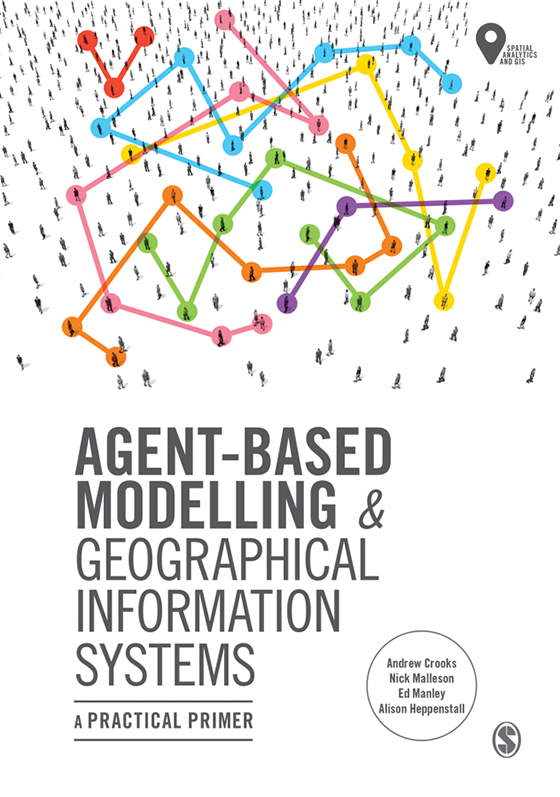

Agent-Based Modelling and Geographical Information Systems
A Practical Primer
December 2018 | 408 pages | Sage UK
| Format | Published Date | ISBN | Price |
|---|
This is the era of Big Data and computational social science. It is an era that requires tools which can do more than visualise data but also model the complex relation between data and human action, and interaction. Agent-Based Models (ABM) - computational models which simulate human action and interaction – do just that.
This textbook explains how to design and build ABM and how to link the models to Geographical Information Systems. It guides you from the basics through to constructing more complex models which work with data and human behaviour in a spatial context. All of the fundamental concepts are explained and related to practical examples to facilitate learning (with models developed in NetLogo with all code examples available on the accompanying website). You will be able to use these models to develop your own applications and link, where appropriate, to Geographical Information Systems.
All of the key ideas and methods are explained in detail:
- geographical modelling;
- an introduction to ABM;
- the fundamentals of Geographical Information Science;
- why ABM and GIS;
- using QGIS;
- designing and building an ABM;
- calibration and validation;
- modelling human behavior.
An applied primer, that provides fundamental knowledge and practical skills, it will provide you with the skills to build and run your own models, and to begin your own research projects.
Table Of Contents:
- Chapter 1 Agent-based Modelling and Geographical Information Systems
- Chapter 2 Introduction to Agent-based Modelling
- Chapter 3 Designing and Developing an Agent-based Model
- Chapter 4 Building Agent-based Models with NetLogo
- Chapter 5 Fundamentals of GIS
- Chapter 6 Integrating Agent-based Models and GIS
- Chapter 7 Modelling Human Behaviour
- Chapter 8 Networks
- Chapter 9 Spatial Statistics
- Chapter 10 Evaluating Models: Verification, Calibration, Validation
- Chapter 11 Alternative Modelling Approaches
- Chapter 12 Summary and Outlook
- Appendix