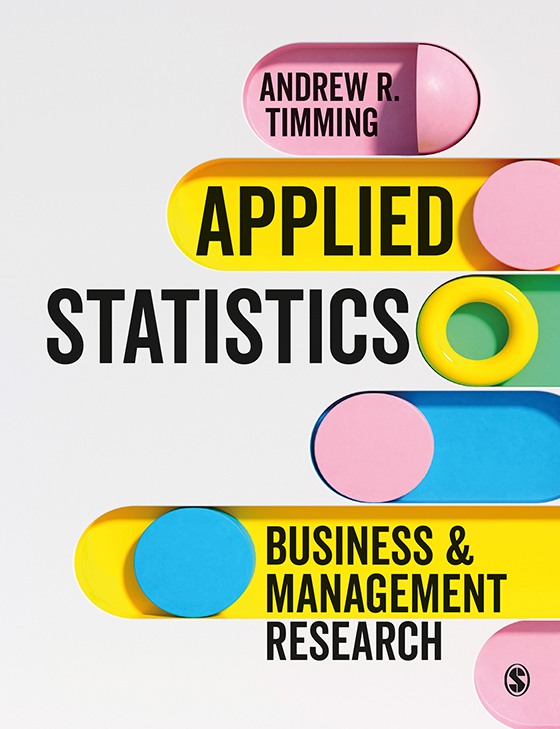
Applied Statistics
Business and Management Research
Andrew R. Timming
- College of Business, Alfaisal University, Riyadh, Saudi Arabia
If you’re in North America, please visit our Sage College Publishing website to purchase or sample this book:
Go to College Publishing WebsiteDescription
Written for the non-mathematician and free of unexplained technical jargon, Applied Statistics: Business and Management Research provides a user-friendly introduction to the field of applied statistics and data analysis.
Featuring step-by-step explanations of how to carry out successful quantitative research, and supported by examples from IBM® SPSS® Statistics, this textbook is an essential resource for students and researchers of business and management.
A range of online resources for both students and lecturers, including a teaching guide, PowerPoint slides and datasets, are available via the companion website.
Andrew R. Timming is Professor of Human Resource Management and Deputy Dean Research & Innovation in the School of Management at RMIT University, Australia.
Featuring step-by-step explanations of how to carry out successful quantitative research, and supported by examples from IBM® SPSS® Statistics, this textbook is an essential resource for students and researchers of business and management.
A range of online resources for both students and lecturers, including a teaching guide, PowerPoint slides and datasets, are available via the companion website.
Andrew R. Timming is Professor of Human Resource Management and Deputy Dean Research & Innovation in the School of Management at RMIT University, Australia.
Contents
Part I: Foundations
- Chapter 1: Introduction to Statistics
- Chapter 2: Exploring IBM SPSS
- Chapter 3: Descriptive Statistics and Graphical Representations
- Chapter 4: The Principle of Statistical Inference
Part II: Comparing Means
- Chapter 5: The T-Test
- Chapter 6: Analysis of Variance
Part III: Non-Parametric and Correlational Relationships
- Chapter 7: Chi-Square
- Chapter 8: Simple Regression and Pearson’s r
Part IV: Multivariate Modeling
- Chapter 9: Multiple Regression
- Chapter 10: Logistic Regression
- Chapter 11: Exploratory and Confirmatory Factor Analyses
- Chapter 12: Structural Equation Modeling
Description
Written for the non-mathematician and free of unexplained technical jargon, Applied Statistics: Business and Management Research provides a user-friendly introduction to the field of applied statistics and data analysis.
Featuring step-by-step explanations of how to carry out successful quantitative research, and supported by examples from IBM® SPSS® Statistics, this textbook is an essential resource for students and researchers of business and management.
A range of online resources for both students and lecturers, including a teaching guide, PowerPoint slides and datasets, are available via the companion website.
Andrew R. Timming is Professor of Human Resource Management and Deputy Dean Research & Innovation in the School of Management at RMIT University, Australia.
Featuring step-by-step explanations of how to carry out successful quantitative research, and supported by examples from IBM® SPSS® Statistics, this textbook is an essential resource for students and researchers of business and management.
A range of online resources for both students and lecturers, including a teaching guide, PowerPoint slides and datasets, are available via the companion website.
Andrew R. Timming is Professor of Human Resource Management and Deputy Dean Research & Innovation in the School of Management at RMIT University, Australia.
Contents
Part I: Foundations
- Chapter 1: Introduction to Statistics
- Chapter 2: Exploring IBM SPSS
- Chapter 3: Descriptive Statistics and Graphical Representations
- Chapter 4: The Principle of Statistical Inference
Part II: Comparing Means
- Chapter 5: The T-Test
- Chapter 6: Analysis of Variance
Part III: Non-Parametric and Correlational Relationships
- Chapter 7: Chi-Square
- Chapter 8: Simple Regression and Pearson’s r
Part IV: Multivariate Modeling
- Chapter 9: Multiple Regression
- Chapter 10: Logistic Regression
- Chapter 11: Exploratory and Confirmatory Factor Analyses
- Chapter 12: Structural Equation Modeling

May 2022 | 456 pages | Sage UK
| Format | Published Date | ISBN | Price |
|---|
Written for the non-mathematician and free of unexplained technical jargon, Applied Statistics: Business and Management Research provides a user-friendly introduction to the field of applied statistics and data analysis.
Featuring step-by-step explanations of how to carry out successful quantitative research, and supported by examples from IBM® SPSS® Statistics, this textbook is an essential resource for students and researchers of business and management.
A range of online resources for both students and lecturers, including a teaching guide, PowerPoint slides and datasets, are available via the companion website.
Andrew R. Timming is Professor of Human Resource Management and Deputy Dean Research & Innovation in the School of Management at RMIT University, Australia.
Featuring step-by-step explanations of how to carry out successful quantitative research, and supported by examples from IBM® SPSS® Statistics, this textbook is an essential resource for students and researchers of business and management.
A range of online resources for both students and lecturers, including a teaching guide, PowerPoint slides and datasets, are available via the companion website.
Andrew R. Timming is Professor of Human Resource Management and Deputy Dean Research & Innovation in the School of Management at RMIT University, Australia.
Table Of Contents:
- Part I: Foundations
- Chapter 1: Introduction to Statistics
- Chapter 2: Exploring IBM SPSS
- Chapter 3: Descriptive Statistics and Graphical Representations
- Chapter 4: The Principle of Statistical Inference
- Part II: Comparing Means
- Chapter 5: The T-Test
- Chapter 6: Analysis of Variance
- Part III: Non-Parametric and Correlational Relationships
- Chapter 7: Chi-Square
- Chapter 8: Simple Regression and Pearson’s r
- Part IV: Multivariate Modeling
- Chapter 9: Multiple Regression
- Chapter 10: Logistic Regression
- Chapter 11: Exploratory and Confirmatory Factor Analyses
- Chapter 12: Structural Equation Modeling