Exploring Social Issues
If you’re in North America, please visit our Sage College Publishing website to purchase or sample this book:
Go to College Publishing WebsiteDescription

A hands-on introduction to the craft of social research for Introductory Sociology courses, Exploring Social Issues: Using SPSS for Windows, Third Edition puts students in the role of active researchers as they test their own ideas about topics such as divorce, abortion, crime, inequality, prejudice, and television violence using SPSS, the pre-eminent software program in the social sciences.
This Third Edition uses updated General Social Survey (GSS) data sets and offers a robust SPSS primer in an appendix. The book is available in two formats: as a stand-alone text, or bundled with SPSS (Student Version).
Key Features
- Stresses active and collaborative learning as students engage in a series of investigative explorations of social issues
- Shows students how analyzing data from the General Social Survey, a major national research program, can help them better understand compelling social issues
- Teaches students how to use SPSS as they analyze GSS data on a random sample of the population
- Guides students step-by-step through exercises that have been designed for those with no background in SPSS
- Includes research reports that follow a standardized fill-in-the-blank format for analyzing and presenting results, but with space left for students to summarize their results in their own words
Exploring Social Issues: Using SPSS for Windows, Third Edition can be effectively used in Introductory Sociology or other undergraduate sociology courses and may be used in conjunction with most of the standard textbooks in the field. The text is ideal for courses where the professor also wants to introduce students to doing social research and using SPSS.
Data sets available online! Click on 'Sample Materials and Chapters' on the left hand menu bar. These data sets provide historical depth, and allow students to analyze trends over time by comparing 2006 results and patterns with data from the 1972 General Social Survey.
Contents
1. Getting Started: Social Research, Data Sets, and Frequency Distributions
1. Getting Started: Social Research, Data Sets, and Frequency Distributions
2. Theory and Research: The Scientific Method
2. Theory and Research: The Scientific Method
3. Describing the Sample, Types of Variables, and Data Sets
3. Describing the Sample, Types of Variables, and Data Sets
4. Culture: What Do Americans Value?
4. Culture: What Do Americans Value?
5. A Controversy in Values: Attitudes About Abortion
5. A Controversy in Values: Attitudes About Abortion
6. Socialization: What Kinds of Children Do Americans Want?
6. Socialization: What Kinds of Children Do Americans Want?
7. Crime: Fear, Law Enforcement, and Punishment
7. Crime: Fear, Law Enforcement, and Punishment
8. Inequality and Social Class in the United States
8. Inequality and Social Class in the United States
9. Inequality and Gender
9. Inequality and Gender
10. Inequality and Race
10. Inequality and Race
11. The Family Institution: Forms and Functions
11. The Family Institution: Forms and Functions
12. The Political Institution in the United States: Support for Civil Liberties, Presidential Choice, and the Gender Gap
12. The Political Institution in the United States: Support for Civil Liberties, Presidential Choice, and the Gender Gap
Appendix A: Variable Names, Item Wordings, and Codes for All Data Sets
Appendix A: Variable Names, Item Wordings, and Codes for All Data Sets
Appendix B: SPSS Commands Used in This Book
Appendix B: SPSS Commands Used in This Book
Answers to Selected Exercises
Answers to Selected Exercises
Glossary of Key Concepts
Glossary of Key Concepts
Description
A hands-on introduction to the craft of social research for Introductory Sociology courses, Exploring Social Issues: Using SPSS for Windows, Third Edition puts students in the role of active researchers as they test their own ideas about topics such as divorce, abortion, crime, inequality, prejudice, and television violence using SPSS, the pre-eminent software program in the social sciences.
This Third Edition uses updated General Social Survey (GSS) data sets and offers a robust SPSS primer in an appendix. The book is available in two formats: as a stand-alone text, or bundled with SPSS (Student Version).
Key Features
- Stresses active and collaborative learning as students engage in a series of investigative explorations of social issues
- Shows students how analyzing data from the General Social Survey, a major national research program, can help them better understand compelling social issues
- Teaches students how to use SPSS as they analyze GSS data on a random sample of the population
- Guides students step-by-step through exercises that have been designed for those with no background in SPSS
- Includes research reports that follow a standardized fill-in-the-blank format for analyzing and presenting results, but with space left for students to summarize their results in their own words
Exploring Social Issues: Using SPSS for Windows, Third Edition can be effectively used in Introductory Sociology or other undergraduate sociology courses and may be used in conjunction with most of the standard textbooks in the field. The text is ideal for courses where the professor also wants to introduce students to doing social research and using SPSS.
Data sets available online! Click on 'Sample Materials and Chapters' on the left hand menu bar. These data sets provide historical depth, and allow students to analyze trends over time by comparing 2006 results and patterns with data from the 1972 General Social Survey.
Contents
1. Getting Started: Social Research, Data Sets, and Frequency Distributions
1. Getting Started: Social Research, Data Sets, and Frequency Distributions
2. Theory and Research: The Scientific Method
2. Theory and Research: The Scientific Method
3. Describing the Sample, Types of Variables, and Data Sets
3. Describing the Sample, Types of Variables, and Data Sets
4. Culture: What Do Americans Value?
4. Culture: What Do Americans Value?
5. A Controversy in Values: Attitudes About Abortion
5. A Controversy in Values: Attitudes About Abortion
6. Socialization: What Kinds of Children Do Americans Want?
6. Socialization: What Kinds of Children Do Americans Want?
7. Crime: Fear, Law Enforcement, and Punishment
7. Crime: Fear, Law Enforcement, and Punishment
8. Inequality and Social Class in the United States
8. Inequality and Social Class in the United States
9. Inequality and Gender
9. Inequality and Gender
10. Inequality and Race
10. Inequality and Race
11. The Family Institution: Forms and Functions
11. The Family Institution: Forms and Functions
12. The Political Institution in the United States: Support for Civil Liberties, Presidential Choice, and the Gender Gap
12. The Political Institution in the United States: Support for Civil Liberties, Presidential Choice, and the Gender Gap
Appendix A: Variable Names, Item Wordings, and Codes for All Data Sets
Appendix A: Variable Names, Item Wordings, and Codes for All Data Sets
Appendix B: SPSS Commands Used in This Book
Appendix B: SPSS Commands Used in This Book
Answers to Selected Exercises
Answers to Selected Exercises
Glossary of Key Concepts
Glossary of Key Concepts
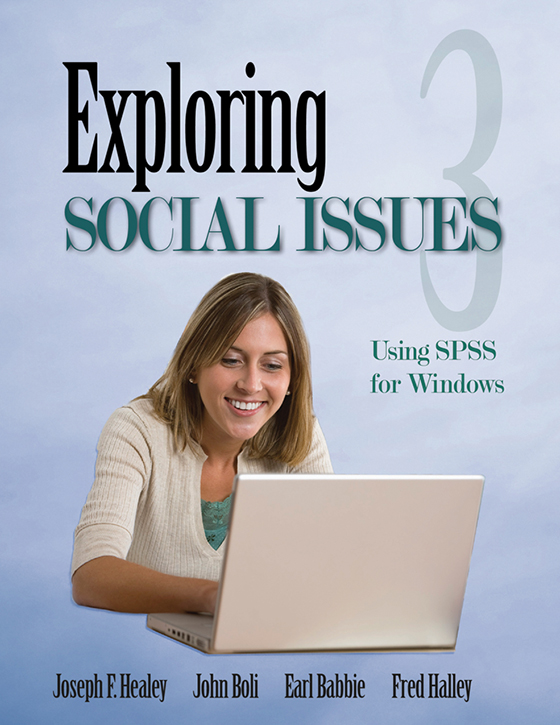

Exploring Social Issues
Using SPSS for Windows
February 2009 | 376 pages | Sage US
| Format | Published Date | ISBN | Price |
|---|
A hands-on introduction to the craft of social research for Introductory Sociology courses, Exploring Social Issues: Using SPSS for Windows, Third Edition puts students in the role of active researchers as they test their own ideas about topics such as divorce, abortion, crime, inequality, prejudice, and television violence using SPSS, the pre-eminent software program in the social sciences.
This Third Edition uses updated General Social Survey (GSS) data sets and offers a robust SPSS primer in an appendix. The book is available in two formats: as a stand-alone text, or bundled with SPSS (Student Version).
Key Features
- Stresses active and collaborative learning as students engage in a series of investigative explorations of social issues
- Shows students how analyzing data from the General Social Survey, a major national research program, can help them better understand compelling social issues
- Teaches students how to use SPSS as they analyze GSS data on a random sample of the population
- Guides students step-by-step through exercises that have been designed for those with no background in SPSS
- Includes research reports that follow a standardized fill-in-the-blank format for analyzing and presenting results, but with space left for students to summarize their results in their own words
Exploring Social Issues: Using SPSS for Windows, Third Edition can be effectively used in Introductory Sociology or other undergraduate sociology courses and may be used in conjunction with most of the standard textbooks in the field. The text is ideal for courses where the professor also wants to introduce students to doing social research and using SPSS.
Data sets available online! Click on 'Sample Materials and Chapters' on the left hand menu bar. These data sets provide historical depth, and allow students to analyze trends over time by comparing 2006 results and patterns with data from the 1972 General Social Survey.
Table Of Contents:
- 1. Getting Started: Social Research, Data Sets, and Frequency Distributions
- 2. Theory and Research: The Scientific Method
- 3. Describing the Sample, Types of Variables, and Data Sets
- 4. Culture: What Do Americans Value?
- 5. A Controversy in Values: Attitudes About Abortion
- 6. Socialization: What Kinds of Children Do Americans Want?
- 7. Crime: Fear, Law Enforcement, and Punishment
- 8. Inequality and Social Class in the United States
- 9. Inequality and Gender
- 10. Inequality and Race
- 11. The Family Institution: Forms and Functions
- 12. The Political Institution in the United States: Support for Civil Liberties, Presidential Choice, and the Gender Gap
- Appendix A: Variable Names, Item Wordings, and Codes for All Data Sets
- Appendix B: SPSS Commands Used in This Book
- Answers to Selected Exercises
- Glossary of Key Concepts