Multilevel Modeling
If you’re in North America, please visit our Sage College Publishing website to purchase or sample this book:
Go to College Publishing WebsiteDescription
Multilevel Modeling: Applications in STATA®, IBM® SPSS®, SAS®, R & HLM™ provides a gentle, hands-on illustration of the most common types of multilevel modeling software, offering instructors multiple software resources for their students and an applications-based foundation for teaching multilevel modeling in the social sciences. Author G. David Garson’s step-by-step instructions for software walk readers through each package. The instructions for the different platforms allow students to get a running start using the package with which they are most familiar while the instructor can start teaching the concepts of multilevel modeling right away. Instructors will find this text serves as both a comprehensive resource for their students and a foundation for their teaching alike.
Contents
Preface
Preface
Acknowledgments
Acknowledgments
About the Author
- Chapter 1 • Introduction to Multilevel Modeling
- Overview
- What Multilevel Modeling Does
- The Importance of Multilevel Theory
- Types of Multilevel Data
- Common Types of Multilevel Model
- Mediation and Moderation Models in Multilevel Analysis
- Alternative Statistical Packages
- Multilevel Modeling Versus GEE
- Summary
- Glossary
- Challenge Questions With Answers
- Chapter 2 • Assumptions of Multilevel Modeling
- About This Chapter
- Overview
- Model Specification
- Construct Operationalization and Validation
- Random Sampling
- Sample Size
- Balanced and Unbalanced Designs
- Data Level
- Linearity and Nonlinearity
- Independence
- Recursivity
- Missing Data
- Outliers
- Centered and Standardized Data
- Longitudinal Time Values
- Multicollinearity
- Homogeneity of Error Variance
- Normally Distributed Residuals
- Normal Distribution of Variables
- Normal Distribution of Random Effects
- Convergence
- Covariance Structure Assumptions
- Summary
- Glossary
- Challenge Questions With Answers
- Chapter 3 • The Null Model
- Overview
- Testing the Need for Multilevel Modeling
- Likelihood Ratio Tests
- Partition of Variance Components
- Examples
- Summary
- Glossary
- Challenge Questions With Answers
- Chapter 4 • Estimating Multilevel Models
- Fixed and Random Effects
- Why Not Just Use OLS Regression?
- Why Not Just Use GLM (ANOVA)?
- Types of Estimation
- Robust and Cluster-Robust Standard Errors
- Summary
- Glossary
- Challenge Questions With Answers
- Chapter 5 • Goodness of Fit and Effect Size in Multilevel Models
- Overview
- Goodness of Fit Measures and Tests
- Effect Size Measures
- Effect Size and Endogeneity
- Summary
- Glossary
- Challenge Questions With Answers
- Chapter 6 • The Two-Level Random Intercept Model
- Overview
- SPSS
- Stata
- SAS
- HLM 7
- R
- Summary
- Glossary
- Challenge Questions With Answers
- Chapter 7 • The Two-Level Random Coefficients Model
- Overview
- SPSS
- Stata
- SAS
- HLM 7
- R
- Significance (p) Values for Variance Components
- Summary
- Glossary
- Challenge Questions With Answers
- Chapter 8 • The Three-Level Unconditional Random Intercept Model with Longitudinal Data
- Overview
- SPSS
- Stata
- SAS
- HLM 7
- R
- Summary
- Glossary
- Challenge Questions With Answers
- Chapter 9 • Repeated Measures and Heterogeneous Variance Models
- Overview
- SPSS
- SAS
- Stata
- R
- HLM 7
- Summary
- Glossary
- Challenge Questions With Answers
- Chapter 10 • Residual and Influence Analysis for a Three-Level RC Model
- About This Chapter
- Overview
- Why Residual Analysis?
- Data
- Model
- Model Diagnostics
- SAS
- Stata
- SPSS
- HLM 7
- R
- Summary
- Glossary
- Challenge Questions With Answers
- Chapter 11 • Cross-Classified Linear Mixed Models
- Overview
- Data
- Model
- Research Purpose
- Stata
- SPSS
- SAS
- HLM 7
- R
- Summary
- Glossary
- Challenge Questions With Answers
- Chapter 12 • Generalized Linear Mixed Models
- Overview
- Estimation Methods
- Data
- Model
- Stata
- SAS
- SPSS
- HLM 7
- R
- Summary
- Glossary
- Challenge Questions With Answers
Appendix 1: Data Used in Examples. Refers to Student Companion Website
Appendix 1: Data Used in Examples. Refers to Student Companion Website
Appendix 2: Reporting Multilevel Results
Appendix 2: Reporting Multilevel Results
References
References
Index
Index
Additional materials
Description
Multilevel Modeling: Applications in STATA®, IBM® SPSS®, SAS®, R & HLM™ provides a gentle, hands-on illustration of the most common types of multilevel modeling software, offering instructors multiple software resources for their students and an applications-based foundation for teaching multilevel modeling in the social sciences. Author G. David Garson’s step-by-step instructions for software walk readers through each package. The instructions for the different platforms allow students to get a running start using the package with which they are most familiar while the instructor can start teaching the concepts of multilevel modeling right away. Instructors will find this text serves as both a comprehensive resource for their students and a foundation for their teaching alike.
Contents
Preface
Preface
Acknowledgments
Acknowledgments
About the Author
- Chapter 1 • Introduction to Multilevel Modeling
- Overview
- What Multilevel Modeling Does
- The Importance of Multilevel Theory
- Types of Multilevel Data
- Common Types of Multilevel Model
- Mediation and Moderation Models in Multilevel Analysis
- Alternative Statistical Packages
- Multilevel Modeling Versus GEE
- Summary
- Glossary
- Challenge Questions With Answers
- Chapter 2 • Assumptions of Multilevel Modeling
- About This Chapter
- Overview
- Model Specification
- Construct Operationalization and Validation
- Random Sampling
- Sample Size
- Balanced and Unbalanced Designs
- Data Level
- Linearity and Nonlinearity
- Independence
- Recursivity
- Missing Data
- Outliers
- Centered and Standardized Data
- Longitudinal Time Values
- Multicollinearity
- Homogeneity of Error Variance
- Normally Distributed Residuals
- Normal Distribution of Variables
- Normal Distribution of Random Effects
- Convergence
- Covariance Structure Assumptions
- Summary
- Glossary
- Challenge Questions With Answers
- Chapter 3 • The Null Model
- Overview
- Testing the Need for Multilevel Modeling
- Likelihood Ratio Tests
- Partition of Variance Components
- Examples
- Summary
- Glossary
- Challenge Questions With Answers
- Chapter 4 • Estimating Multilevel Models
- Fixed and Random Effects
- Why Not Just Use OLS Regression?
- Why Not Just Use GLM (ANOVA)?
- Types of Estimation
- Robust and Cluster-Robust Standard Errors
- Summary
- Glossary
- Challenge Questions With Answers
- Chapter 5 • Goodness of Fit and Effect Size in Multilevel Models
- Overview
- Goodness of Fit Measures and Tests
- Effect Size Measures
- Effect Size and Endogeneity
- Summary
- Glossary
- Challenge Questions With Answers
- Chapter 6 • The Two-Level Random Intercept Model
- Overview
- SPSS
- Stata
- SAS
- HLM 7
- R
- Summary
- Glossary
- Challenge Questions With Answers
- Chapter 7 • The Two-Level Random Coefficients Model
- Overview
- SPSS
- Stata
- SAS
- HLM 7
- R
- Significance (p) Values for Variance Components
- Summary
- Glossary
- Challenge Questions With Answers
- Chapter 8 • The Three-Level Unconditional Random Intercept Model with Longitudinal Data
- Overview
- SPSS
- Stata
- SAS
- HLM 7
- R
- Summary
- Glossary
- Challenge Questions With Answers
- Chapter 9 • Repeated Measures and Heterogeneous Variance Models
- Overview
- SPSS
- SAS
- Stata
- R
- HLM 7
- Summary
- Glossary
- Challenge Questions With Answers
- Chapter 10 • Residual and Influence Analysis for a Three-Level RC Model
- About This Chapter
- Overview
- Why Residual Analysis?
- Data
- Model
- Model Diagnostics
- SAS
- Stata
- SPSS
- HLM 7
- R
- Summary
- Glossary
- Challenge Questions With Answers
- Chapter 11 • Cross-Classified Linear Mixed Models
- Overview
- Data
- Model
- Research Purpose
- Stata
- SPSS
- SAS
- HLM 7
- R
- Summary
- Glossary
- Challenge Questions With Answers
- Chapter 12 • Generalized Linear Mixed Models
- Overview
- Estimation Methods
- Data
- Model
- Stata
- SAS
- SPSS
- HLM 7
- R
- Summary
- Glossary
- Challenge Questions With Answers
Appendix 1: Data Used in Examples. Refers to Student Companion Website
Appendix 1: Data Used in Examples. Refers to Student Companion Website
Appendix 2: Reporting Multilevel Results
Appendix 2: Reporting Multilevel Results
References
References
Index
Index
Additional materials
Reviews
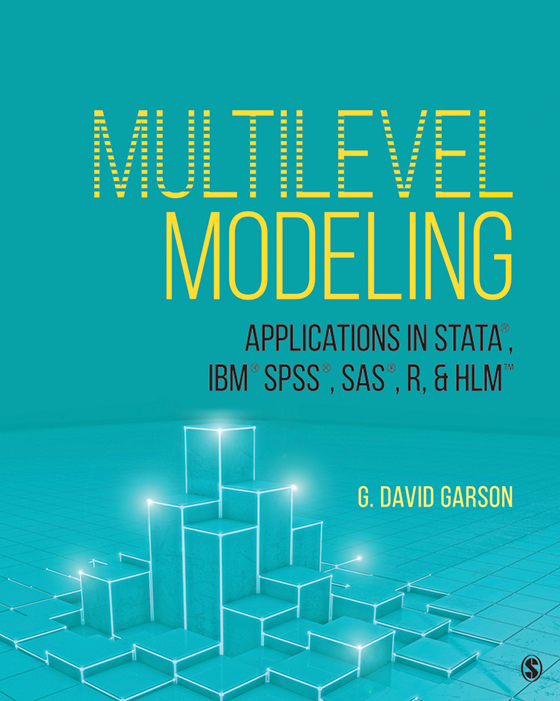

Multilevel Modeling
Applications in STATA®, IBM® SPSS®, SAS®, R, & HLM™
August 2019 | 552 pages | Sage US
| Format | Published Date | ISBN | Price |
|---|
Multilevel Modeling: Applications in STATA®, IBM® SPSS®, SAS®, R & HLM™ provides a gentle, hands-on illustration of the most common types of multilevel modeling software, offering instructors multiple software resources for their students and an applications-based foundation for teaching multilevel modeling in the social sciences. Author G. David Garson’s step-by-step instructions for software walk readers through each package. The instructions for the different platforms allow students to get a running start using the package with which they are most familiar while the instructor can start teaching the concepts of multilevel modeling right away. Instructors will find this text serves as both a comprehensive resource for their students and a foundation for their teaching alike.
Table Of Contents:
- Preface
- Acknowledgments
- About the Author
- Chapter 1 • Introduction to Multilevel Modeling
- Overview
- What Multilevel Modeling Does
- The Importance of Multilevel Theory
- Types of Multilevel Data
- Common Types of Multilevel Model
- Mediation and Moderation Models in Multilevel Analysis
- Alternative Statistical Packages
- Multilevel Modeling Versus GEE
- Summary
- Glossary
- Challenge Questions With Answers
- Chapter 2 • Assumptions of Multilevel Modeling
- About This Chapter
- Overview
- Model Specification
- Construct Operationalization and Validation
- Random Sampling
- Sample Size
- Balanced and Unbalanced Designs
- Data Level
- Linearity and Nonlinearity
- Independence
- Recursivity
- Missing Data
- Outliers
- Centered and Standardized Data
- Longitudinal Time Values
- Multicollinearity
- Homogeneity of Error Variance
- Normally Distributed Residuals
- Normal Distribution of Variables
- Normal Distribution of Random Effects
- Convergence
- Covariance Structure Assumptions
- Summary
- Glossary
- Challenge Questions With Answers
- Chapter 3 • The Null Model
- Overview
- Testing the Need for Multilevel Modeling
- Likelihood Ratio Tests
- Partition of Variance Components
- Examples
- Summary
- Glossary
- Challenge Questions With Answers
- Chapter 4 • Estimating Multilevel Models
- Fixed and Random Effects
- Why Not Just Use OLS Regression?
- Why Not Just Use GLM (ANOVA)?
- Types of Estimation
- Robust and Cluster-Robust Standard Errors
- Summary
- Glossary
- Challenge Questions With Answers
- Chapter 5 • Goodness of Fit and Effect Size in Multilevel Models
- Overview
- Goodness of Fit Measures and Tests
- Effect Size Measures
- Effect Size and Endogeneity
- Summary
- Glossary
- Challenge Questions With Answers
- Chapter 6 • The Two-Level Random Intercept Model
- Overview
- SPSS
- Stata
- SAS
- HLM 7
- R
- Summary
- Glossary
- Challenge Questions With Answers
- Chapter 7 • The Two-Level Random Coefficients Model
- Overview
- SPSS
- Stata
- SAS
- HLM 7
- R
- Significance (p) Values for Variance Components
- Summary
- Glossary
- Challenge Questions With Answers
- Chapter 8 • The Three-Level Unconditional Random Intercept Model with Longitudinal Data
- Overview
- SPSS
- Stata
- SAS
- HLM 7
- R
- Summary
- Glossary
- Challenge Questions With Answers
- Chapter 9 • Repeated Measures and Heterogeneous Variance Models
- Overview
- SPSS
- SAS
- Stata
- R
- HLM 7
- Summary
- Glossary
- Challenge Questions With Answers
- Chapter 10 • Residual and Influence Analysis for a Three-Level RC Model
- About This Chapter
- Overview
- Why Residual Analysis?
- Data
- Model
- Model Diagnostics
- SAS
- Stata
- SPSS
- HLM 7
- R
- Summary
- Glossary
- Challenge Questions With Answers
- Chapter 11 • Cross-Classified Linear Mixed Models
- Overview
- Data
- Model
- Research Purpose
- Stata
- SPSS
- SAS
- HLM 7
- R
- Summary
- Glossary
- Challenge Questions With Answers
- Chapter 12 • Generalized Linear Mixed Models
- Overview
- Estimation Methods
- Data
- Model
- Stata
- SAS
- SPSS
- HLM 7
- R
- Summary
- Glossary
- Challenge Questions With Answers
- Appendix 1: Data Used in Examples. Refers to Student Companion Website
- Appendix 2: Reporting Multilevel Results
- References
- Index