Operations Management
Managing Global Supply Chains
Second Edition
Ray R. Venkataraman
- Penn State Erie, The Behrend College
If you’re in North America, please visit our Sage College Publishing website to purchase or sample this book:
Go to College Publishing WebsiteDescription
Operations Management: Managing Global Supply Chains takes a holistic, integrated approach to managing operations and supply chains by exploring the strategic, tactical, and operational decisions and challenges facing organizations worldwide. Authors Ray R. Venkataraman and Jeffrey K. Pinto address sustainability in each chapter, showing that sustainable operations and supply chain practices are not only attainable, but are critical and often profitable practices for organizations to undertake. With a focus on critical thinking and problem solving, Operations Management provides students with a comprehensive introduction to the field and equips them with the tools necessary to thrive in today’s evolving global business environment.
A Complete Teaching & Learning Package
SAGE coursepacks
FREE! Easily import our quality instructor and student resource content into your school’s learning management system (LMS) and save time. Learn more.
SAGE edge
FREE online resources for students that make learning easier. See how your students benefit.
A Complete Teaching & Learning Package
SAGE coursepacks
FREE! Easily import our quality instructor and student resource content into your school’s learning management system (LMS) and save time. Learn more.
SAGE edge
FREE online resources for students that make learning easier. See how your students benefit.
Contents
Preface
Preface
Acknowledgments
Acknowledgments
About the Authors
About the Authors
PART I: INTRODUCTION
- Chapter 1: Introduction to Managing Global Operations and Supply Chains
- 1.1 Supply Chains and Operations Management in the Global Economy
- 1.2 What Does Operations Management Entail?
- 1.3 What Does Supply Chain Management Entail?
- 1.4 An Integrated Perspective on Operations and Supply Chain Management
- 1.5 The Evolution of Operations and Supply Chain Management
- 1.6 Current and Emerging Issues in Operations and Supply Chain Management
- 1.7 Road Map: How This Text Is Organized
- Chapter Summary
- Key Terms
- Discussion and Review Questions
- Problems
- Case Study 1.1 Multinational Companies and China: Investing for the Long Term
- Case Study 1.2 Nintendo’s Wii and Wii U: Absence Makes the Heart Grow Fonder
- Video Case
- Critical Thinking Exercise
PART II: STRATEGIC DECISIONS
- Chapter 2: Operations and Supply Chain Strategies
- 2.1 Levels of Strategic Planning
- 2.2 Formulating and Evaluating Operations Strategies
- 2.3 Formulating and Evaluating Strategies for Service Organizations
- 2.4 Measuring Productivity as Part of Strategic Planning
- 2.5 Strategies for Supply Chains
- 2.6 Global Strategies
- 2.7 Sustainability Issues
- Chapter Summary
- Key Terms
- Discussion and Review Questions
- Solved Problems
- Problems
- Case Study 2.1 Supply Chain Strategies and Disaster Planning
- Video Case
- Critical Thinking Exercise
- Chapter 3: Project Management
- 3.1 Projects, Project Teams, and Measuring Success
- 3.2 Project Life Cycles
- 3.3 Conceptualizing and Planning Projects
- 3.4 Scheduling Projects
- 3.5 Supply Chains for Projects
- 3.6 Executing, Evaluating, and Terminating Projects
- 3.7 Sustainability Issues
- 3.8 Global Projects
- Chapter Summary
- Key Terms
- Discussion and Review Questions
- Solved Problems
- Problems
- Case Study 3.1 Project Management in the Movie Business
- Video Case
- Critical Thinking Exercise
- Supplement for Chapter 3: Project Management
- 3S.1 Determining the Probability of a Project Being Completed on Time
- 3S.2 Calculating the Time-Cost Trade-Offs of Crashing a Project
- 3S.3 Calculating a Project’s Earned Value
- Supplement Summary
- Key Terms
- Discussion and Review Questions
- Solved Problems
- Problems
- Critical Thinking Exercise
- Chapter 4: Product and Service Innovations
- 4.1 Why Companies Develop New Products and Services
- 4.2 How New Products Are Developed
- 4.3 New Product Development Concepts and Strategies
- 4.4 Using Technology to Develop New Products
- 4.5 Global Product Development
- 4.6 New Product Development Issues for Supply Chains
- 4.7 How Services Are Designed
- 4.8 Legal, Ethical, and Sustainability Issues
- Chapter Summary
- Key Terms
- Discussion and Review Questions
- Problems
- Case Study 4.1 Redesigning for Efficiency: The Chevrolet Malibu
- Video Case
- Critical Thinking Exercise
- Supplement for Chapter 4: Reliability
- 4S.1 Understanding Reliability
- 4S.2 Availability and Maintainability
- Supplement Summary
- Key Terms
- Discussion and Review Questions
- Solved Problems
- Problems
- Chapter 5: Managing for Quality
- 5.1 Defining Quality
- 5.2 The Benefits and Costs of Managing Quality
- 5.3 The Evolution of Quality Management and Its Pioneers
- 5.4 Major Quality Management Initiatives
- 5.5 Quality Management Tools and Techniques
- 5.6 Managing Quality for Supply Chains
- 5.7 Global Quality Management
- 5.8 Legal, Ethical, and Sustainability Issues,
- Chapter Summary
- Key Terms
- Discussion and Review Questions
- Problems
- Case Study 5.1 Pfizer Fixes Problems With Its Cleaning Processes
- Case Study 5.2 Partnering to Improve Quality
- Case Study 5.3 3M: Finding the Delicate Balance Between Six Sigma and Innovation
- Case Study 5.4 Van Halen, Brown M&Ms, and Quality Control
- Video Case
- Critical Thinking Exercise
- Chapter 6: Quality Improvement and Control Tools
- 6.1 Quality Control Versus Quality Assurance
- 6.2 Quality Appraisal Tools
- 6.3 Quality Defect Prevention Tools
- 6.4 Quality Design Tools
- Chapter Summary
- Key Terms
- Discussion and Review Questions
- Solved Problems
- Problems
- Case Study 6.1 J.D. Power Automobile Surveys: What Does “Quality” Mean, Anyway?
- Video Case
- Critical Thinking Exercises
- Chapter 7: Capacity Planning
- 7.1 Capacity Planning
- 7.2 Service Capacity Planning
- 7.3 Capacity Planning for Supply Chains
- 7.4 Ethical and Sustainability Issues
- 7.5 Global Capacity Management
- Chapter Summary
- Key Terms
- Discussion and Review Questions
- Solved Problems
- Problems
- Case Study 7.1 Kirwain’s Capacity Planning Challenge
- Video Cases
- Critical Thinking Exercises
- Chapter 8: Supply Chain Design and Location Planning
- 8.1 Supply Chain Design and Facility Location Decisions
- 8.2 Phases in the Supply Chain Design and Location Decision-Making Process
- 8.3 Analytical Methods for Evaluating Locations
- 8.4 Ethical and Sustainability Issues
- 8.5 Global Location Planning
- Chapter Summary
- Key Terms
- Discussion and Review Questions
- Problems
- Case Study 8.1 Countering the Counterfeiters
- Case Study 8.2 Alpharetta Tools
- Video Case
- Critical Thinking Exercise
- Chapter 9: Process Design and Layout Planning
- 9.1 Designing, Selecting, and Redesigning Manufacturing Processes
- 9.2 Designing Service Processes
- 9.3 Designing Processes for Supply Chains
- 9.4 Global Process Design
- 9.5 Layout Planning
- 9.6 Legal, Ethical, and Sustainability Issues
- Chapter Summary
- Key Terms
- Discussion and Review Questions
- Problems
- Case Study 9.1 Challenges of Redesigning a Plant Layout
- Video Case
- Critical Thinking Exercise
- Supplement for Chapter 9: Tools for Analyzing, Designing, and Selecting Processes and Layouts
- 9S.1 Process Selection, Design, and Analysis Tools
- 9S.2 Layout Analysis Tools and Techniques
- Supplement Summary
- Key Terms
- Discussion and Review Questions
- Solved Problems
- Problems
- Critical Thinking Exercises
PART III: INTEGRATIVE DECISIONS
- Chapter 10: Supplier Management
- 10.1 Supplier Management and Its Goals
- 10.2 The Supplier Management Process
- 10.3 Managing Service Providers
- 10.4 Global Supplier Management
- 10.5 Legal, Ethical, and Sustainability Issues
- Chapter Summary
- Key Terms
- Discussion and Review Questions
- Solved Problem
- Problems
- Case Study 10.1 The Boeing
- Video Cases
- Critical Thinking Exercise
- Chapter 11: Logistics Management
- 11.1 Integrated Logistics Management
- 11.2 Order Fulfillment
- 11.3 Transportation Management
- 11.4 Packaging
- 11.5 Materials Handling
- 11.6 Warehousing Management
- 11.7 Inventory Management
- 11.8 Facilities Network Design,
- 11.9 Global Logistics
- 11.10 Logistics Outsourcing
- 11.11 Logistics in the Service Sector
- 11.12 Ethical and Sustainability Issues
- Chapter Summary
- Key Terms
- Discussion and Review Questions
- Problems
- Case Study 11.1 How Sustainable Logistics Solutions and Technologies Have Helped Walmart Become More Efficient
- Case Study 11.2 Third-Party Logistics and the Mistreatment of Workers
- Video Case
- Critical Thinking Exercises
- Chapter 12: Demand Management and Customer Service
- 12.1 Demand Management
- 12.2 Global Demand Management
- 12.3 Services Demand Management
- 12.4 Customer Service and Demand Management
- 12.5 Ethical and Sustainability Issues
- Chapter Summary
- Key Terms
- Discussion and Review Questions
- Problems
- Case Study 12.1 McDonald’s Reinvents Itself, Again
- Case Study 12.2 Predicting the Future Demand for Rural Health Care
- Video Cases
- Critical Thinking Exercises
- Chapter 13: Demand Forecasting Methods
- 13.1 Introduction to Forecasting and Its Applications
- 13.2 The Characteristics of Good Forecasts
- 13.3 Qualitative Versus Quantitative Forecasting Methods
- 13.4 Measuring and Monitoring the Accuracy of Forecasting Methods
- 13.5 Monitoring and Controlling Forecasts
- 13.6 Forecasting for Supply Chains
- 13.7 Ethical Issues
- Chapter Summary
- Key Terms
- Discussion and Review Questions
- Solved Problems
- Problems
- Case Study 13.1 Forecasting Ticket Demand for the Super Bowl
- Case Study 13.2 Ethical Forecasting: If You Torture the Numbers Long Enough, They Can Tell You Anything!
- Video Cases
- Critical Thinking Exercises
PART IV: TACTICAL DECISIONS
- Chapter 14: Lean Operations and Supply Chains
- 14.1 Introduction to Lean Operations
- 14.2 The Philosophy of Lean Systems
- 14.3 Elements of Lean Systems
- 14.4 Lean Services
- 14.5 Lean Supply Chains
- 14.6 Lean Global Supply Chains
- 14.7 Sustainability Issues
- Chapter Summary
- Key Terms
- Discussion and Review Questions
- Solved Problem
- Problems
- Case Study 14.1 Lean Sustainable Supply Chains at Unilever
- Case Study 14.2 TAL Apparel and JCPenney
- Critical Thinking Exercise
- Appendix 14.1: Value Stream Mapping Symbols
- Appendix 14.2: Steps for Developing a Value Stream Map
- Chapter 15: Inventory Management
- 15.1 Types of Inventory
- 15.2 Inventory Costs
- 15.3 Inventory Considerations for Supply Chains
- 15.4 Inventory Management Measures
- 15.5 Key Features of Effective Inventory Management Systems
- 15.6 Uncertainty in Supply Chain Inventories: The Bullwhip Effect
- 15.7 Ethical and Sustainability Issues
- 15.8 Global Inventory Management
- 15.9 Service Sector Inventory Management
- Chapter Summary
- Key Terms
- Discussion and Review Questions
- Solved Problem
- Problems
- Case Study 15.1 Inventory Pressures Cause Tuesday Morning to Abandon e-Commerce
- Case Study 15.2 Inventory Management in the Age of the Online Shopper
- Video Case
- Critical Thinking Exercises
- Chapter 16: Inventory Control Models
- 16.1 How Much to Order: Continuous Review Systems
- 16.2 Economic Production Quantity (EPQ) Model
- 16.3 EOQ Model with Quantity Discounts
- 16.4 When to Order: Reorder Point for Continuous Review Systems (EOQ Model)
- 16.5 How Much to Order: Periodic Review Systems
- 16.6 How Much to Order: Single-Period Inventory Systems
- Chapter Summary
- Key Terms
- Discussion and Review Questions
- Solved Problems
- Problems
- Case Study 16.1 When Your Customers Steer You Wrong: Walmart’s Project Impact Disaster
- Video Case
- Critical Thinking Exercise
- Chapter 17: Sales and Operations Planning
- 17.1 The Basics of Sales and Operations Planning
- 17.2 Benefits of Sales and Operations Planning
- 17.3 Framework of the Sales and Operations Planning Process
- 17.4 Options for Influencing Demand and Supply in Sales and Operations Planning
- 17.5 Sales and Operations Planning Strategies
- 17.6 Methods for Sales and Operations Planning
- 17.7 Sales and Operations Planning for Supply Chains
- 17.8 Sales and Operations Planning in Service Industries
- 17.9 Sustainable S&OP: Sales Carbon Operations Planning (SCOP)
- 17.10 Ethical Issues
- Chapter Summary
- Key Terms
- Discussion and Review Questions
- Solved Problem
- Problems
- Case Study 17.1: Coordinating Sales and Operations Planning for the Next Big Thing: The Case of the Sony PS4 Launch
- Video Case
- Critical Thinking Exercise
PART V: OPERATIONAL DECISIONS
- Chapter 18: Master Scheduling and Material Requirements Planning
- 18.1 Master Scheduling
- 18.2 Material Requirements Planning
- 18.3 Ethical and Sustainability Issues
- Chapter Summary
- Key Terms
- Discussion and Review Questions
- Solved Problems
- Problems
- Case Study 18.1 Bringing Order to a Chaotic Restaurant
- Video Case
- Critical Thinking Exercise
- Supplement for Chapter 18: Capacity Requirements Planning, MRP II, ERP, and DRP
- 18S.1 Capacity Requirements Planning (CRP)
- 18S.2 Manufacturing Resource Planning (MRP II)—An Extension of MRP
- 18S.3 Enterprise Resource Planning (ERP)
- 18S.4 Impact of MRP, MRP II, and ERP on Supply Chains
- 18S.5 Distribution Requirements Planning (DRP)
- 18S.6 Sustainability Issues
- Supplement Summary
- Key Terms
- Discussion and Review Questions
- Solved Problem
- Problems
- Case Study 18S.1 Thinking Outside the Box: Enterprise Training at General Mills
- Critical Thinking Exercise
- Chapter 19: Detailed Scheduling
- 19.1 What Detailed Scheduling Is
- 19.2 Types of Scheduling for Manufacturers
- 19.3 Why Scheduling Is Complex
- 19.4 Scheduling in the Service Sector
- 19.5 Scheduling for Supply Chains
- 19.6 Ethical and Sustainability Issues
- Chapter Summary
- Key Terms
- Discussion and Review Questions
- Solved Problems
- Problems
- Case Study 19.1 Telling Umpires Where to Go!
- Video Case
- Critical Thinking Exercises
PART VI: QUANTITATIVE MODULES
- Module A: Linear Programming
- Introduction
- A.1 Features of a Linear Programming (LP) Problem
- A.2 Solving Linear Programming Problems Using Excel
- A.3 Sensitivity Analysis
- A.4 Additional Linear Programming Models
- Module Summary
- Key Terms
- Discussion and Review Questions
- Solved Problems
- Problems
- Case Study A.1 Happy Hour, Happy Profits
- Module B: The Transportation Models
- B.1 Formulating and Solving the Transportation Problem
- B.2 Additional Issues in Transportation Modeling
- Module Summary
- Key Terms
- Discussion and Review Questions
- Solved Problems
- Problems
- Case Study B.1 Plant Location for Tru-Blade Ski Company
- Module C: Waiting Line Models
- C.1 Introduction to Waiting Line Models
- C.2 Queueing Models
- Module Summary
- Key Terms
- Discussion and Review Questions
- Solved Problems
- Problems
- Case Study C.1 The Psychology of Waiting in Lines
- Questions for Discussion
- Module D: Simulation
- D.1 Introduction to Simulation
- D.2 Monte Carlo Simulation
- Module Summary
- Key Terms
- Discussion and Review Questions
- Solved Problem
- Problems
- Case Study D.1 Staying Ahead of the Demand for Ice Cream
- Module E: Learning Curves
- E.1 What Are Learning Curves?
- E.2 Applications of Learning Curves
- E.3 Approaches to Solving Learning Curve Problems
- E.4 Learning Curves in Cost Estimation
- E.5 Limitations of Learning Curves
- Module Summary
- Key Terms
- Discussion and Review Questions
- Solved Problems
- Problems
- Case Study E.1 Estimating the Cost of a Drilling Platform
- Module F: Decision-Making Tools
- F.1 Using a Systematic Decision-Making Process
- F.2 Elements in the Decision-Making Process
- F.3 Categorizing Decisions
- F.4 Techniques for Making Decisions Under Certainty, Uncertainty, and Risk
- F.5 Techniques for Making Sequential Decisions
- Module Summary
- Key Terms
- Discussion and Review Questions
- Solved Problems
- Problems
- Case Study F.1 Gerber Products Company: The Problem
- Case Study F.2 Gerber Products Company: The Solution
Appendix A: Tables
Appendix A: Tables
Appendix B: Answers to Select Problems
Appendix B: Answers to Select Problems
Glossary
Glossary
Notes
Notes
Company Index
Company Index
Subject Index
Subject Index
Additional materials
Description
Operations Management: Managing Global Supply Chains takes a holistic, integrated approach to managing operations and supply chains by exploring the strategic, tactical, and operational decisions and challenges facing organizations worldwide. Authors Ray R. Venkataraman and Jeffrey K. Pinto address sustainability in each chapter, showing that sustainable operations and supply chain practices are not only attainable, but are critical and often profitable practices for organizations to undertake. With a focus on critical thinking and problem solving, Operations Management provides students with a comprehensive introduction to the field and equips them with the tools necessary to thrive in today’s evolving global business environment.
A Complete Teaching & Learning Package
SAGE coursepacks
FREE! Easily import our quality instructor and student resource content into your school’s learning management system (LMS) and save time. Learn more.
SAGE edge
FREE online resources for students that make learning easier. See how your students benefit.
A Complete Teaching & Learning Package
SAGE coursepacks
FREE! Easily import our quality instructor and student resource content into your school’s learning management system (LMS) and save time. Learn more.
SAGE edge
FREE online resources for students that make learning easier. See how your students benefit.
Contents
Preface
Preface
Acknowledgments
Acknowledgments
About the Authors
About the Authors
PART I: INTRODUCTION
- Chapter 1: Introduction to Managing Global Operations and Supply Chains
- 1.1 Supply Chains and Operations Management in the Global Economy
- 1.2 What Does Operations Management Entail?
- 1.3 What Does Supply Chain Management Entail?
- 1.4 An Integrated Perspective on Operations and Supply Chain Management
- 1.5 The Evolution of Operations and Supply Chain Management
- 1.6 Current and Emerging Issues in Operations and Supply Chain Management
- 1.7 Road Map: How This Text Is Organized
- Chapter Summary
- Key Terms
- Discussion and Review Questions
- Problems
- Case Study 1.1 Multinational Companies and China: Investing for the Long Term
- Case Study 1.2 Nintendo’s Wii and Wii U: Absence Makes the Heart Grow Fonder
- Video Case
- Critical Thinking Exercise
PART II: STRATEGIC DECISIONS
- Chapter 2: Operations and Supply Chain Strategies
- 2.1 Levels of Strategic Planning
- 2.2 Formulating and Evaluating Operations Strategies
- 2.3 Formulating and Evaluating Strategies for Service Organizations
- 2.4 Measuring Productivity as Part of Strategic Planning
- 2.5 Strategies for Supply Chains
- 2.6 Global Strategies
- 2.7 Sustainability Issues
- Chapter Summary
- Key Terms
- Discussion and Review Questions
- Solved Problems
- Problems
- Case Study 2.1 Supply Chain Strategies and Disaster Planning
- Video Case
- Critical Thinking Exercise
- Chapter 3: Project Management
- 3.1 Projects, Project Teams, and Measuring Success
- 3.2 Project Life Cycles
- 3.3 Conceptualizing and Planning Projects
- 3.4 Scheduling Projects
- 3.5 Supply Chains for Projects
- 3.6 Executing, Evaluating, and Terminating Projects
- 3.7 Sustainability Issues
- 3.8 Global Projects
- Chapter Summary
- Key Terms
- Discussion and Review Questions
- Solved Problems
- Problems
- Case Study 3.1 Project Management in the Movie Business
- Video Case
- Critical Thinking Exercise
- Supplement for Chapter 3: Project Management
- 3S.1 Determining the Probability of a Project Being Completed on Time
- 3S.2 Calculating the Time-Cost Trade-Offs of Crashing a Project
- 3S.3 Calculating a Project’s Earned Value
- Supplement Summary
- Key Terms
- Discussion and Review Questions
- Solved Problems
- Problems
- Critical Thinking Exercise
- Chapter 4: Product and Service Innovations
- 4.1 Why Companies Develop New Products and Services
- 4.2 How New Products Are Developed
- 4.3 New Product Development Concepts and Strategies
- 4.4 Using Technology to Develop New Products
- 4.5 Global Product Development
- 4.6 New Product Development Issues for Supply Chains
- 4.7 How Services Are Designed
- 4.8 Legal, Ethical, and Sustainability Issues
- Chapter Summary
- Key Terms
- Discussion and Review Questions
- Problems
- Case Study 4.1 Redesigning for Efficiency: The Chevrolet Malibu
- Video Case
- Critical Thinking Exercise
- Supplement for Chapter 4: Reliability
- 4S.1 Understanding Reliability
- 4S.2 Availability and Maintainability
- Supplement Summary
- Key Terms
- Discussion and Review Questions
- Solved Problems
- Problems
- Chapter 5: Managing for Quality
- 5.1 Defining Quality
- 5.2 The Benefits and Costs of Managing Quality
- 5.3 The Evolution of Quality Management and Its Pioneers
- 5.4 Major Quality Management Initiatives
- 5.5 Quality Management Tools and Techniques
- 5.6 Managing Quality for Supply Chains
- 5.7 Global Quality Management
- 5.8 Legal, Ethical, and Sustainability Issues,
- Chapter Summary
- Key Terms
- Discussion and Review Questions
- Problems
- Case Study 5.1 Pfizer Fixes Problems With Its Cleaning Processes
- Case Study 5.2 Partnering to Improve Quality
- Case Study 5.3 3M: Finding the Delicate Balance Between Six Sigma and Innovation
- Case Study 5.4 Van Halen, Brown M&Ms, and Quality Control
- Video Case
- Critical Thinking Exercise
- Chapter 6: Quality Improvement and Control Tools
- 6.1 Quality Control Versus Quality Assurance
- 6.2 Quality Appraisal Tools
- 6.3 Quality Defect Prevention Tools
- 6.4 Quality Design Tools
- Chapter Summary
- Key Terms
- Discussion and Review Questions
- Solved Problems
- Problems
- Case Study 6.1 J.D. Power Automobile Surveys: What Does “Quality” Mean, Anyway?
- Video Case
- Critical Thinking Exercises
- Chapter 7: Capacity Planning
- 7.1 Capacity Planning
- 7.2 Service Capacity Planning
- 7.3 Capacity Planning for Supply Chains
- 7.4 Ethical and Sustainability Issues
- 7.5 Global Capacity Management
- Chapter Summary
- Key Terms
- Discussion and Review Questions
- Solved Problems
- Problems
- Case Study 7.1 Kirwain’s Capacity Planning Challenge
- Video Cases
- Critical Thinking Exercises
- Chapter 8: Supply Chain Design and Location Planning
- 8.1 Supply Chain Design and Facility Location Decisions
- 8.2 Phases in the Supply Chain Design and Location Decision-Making Process
- 8.3 Analytical Methods for Evaluating Locations
- 8.4 Ethical and Sustainability Issues
- 8.5 Global Location Planning
- Chapter Summary
- Key Terms
- Discussion and Review Questions
- Problems
- Case Study 8.1 Countering the Counterfeiters
- Case Study 8.2 Alpharetta Tools
- Video Case
- Critical Thinking Exercise
- Chapter 9: Process Design and Layout Planning
- 9.1 Designing, Selecting, and Redesigning Manufacturing Processes
- 9.2 Designing Service Processes
- 9.3 Designing Processes for Supply Chains
- 9.4 Global Process Design
- 9.5 Layout Planning
- 9.6 Legal, Ethical, and Sustainability Issues
- Chapter Summary
- Key Terms
- Discussion and Review Questions
- Problems
- Case Study 9.1 Challenges of Redesigning a Plant Layout
- Video Case
- Critical Thinking Exercise
- Supplement for Chapter 9: Tools for Analyzing, Designing, and Selecting Processes and Layouts
- 9S.1 Process Selection, Design, and Analysis Tools
- 9S.2 Layout Analysis Tools and Techniques
- Supplement Summary
- Key Terms
- Discussion and Review Questions
- Solved Problems
- Problems
- Critical Thinking Exercises
PART III: INTEGRATIVE DECISIONS
- Chapter 10: Supplier Management
- 10.1 Supplier Management and Its Goals
- 10.2 The Supplier Management Process
- 10.3 Managing Service Providers
- 10.4 Global Supplier Management
- 10.5 Legal, Ethical, and Sustainability Issues
- Chapter Summary
- Key Terms
- Discussion and Review Questions
- Solved Problem
- Problems
- Case Study 10.1 The Boeing
- Video Cases
- Critical Thinking Exercise
- Chapter 11: Logistics Management
- 11.1 Integrated Logistics Management
- 11.2 Order Fulfillment
- 11.3 Transportation Management
- 11.4 Packaging
- 11.5 Materials Handling
- 11.6 Warehousing Management
- 11.7 Inventory Management
- 11.8 Facilities Network Design,
- 11.9 Global Logistics
- 11.10 Logistics Outsourcing
- 11.11 Logistics in the Service Sector
- 11.12 Ethical and Sustainability Issues
- Chapter Summary
- Key Terms
- Discussion and Review Questions
- Problems
- Case Study 11.1 How Sustainable Logistics Solutions and Technologies Have Helped Walmart Become More Efficient
- Case Study 11.2 Third-Party Logistics and the Mistreatment of Workers
- Video Case
- Critical Thinking Exercises
- Chapter 12: Demand Management and Customer Service
- 12.1 Demand Management
- 12.2 Global Demand Management
- 12.3 Services Demand Management
- 12.4 Customer Service and Demand Management
- 12.5 Ethical and Sustainability Issues
- Chapter Summary
- Key Terms
- Discussion and Review Questions
- Problems
- Case Study 12.1 McDonald’s Reinvents Itself, Again
- Case Study 12.2 Predicting the Future Demand for Rural Health Care
- Video Cases
- Critical Thinking Exercises
- Chapter 13: Demand Forecasting Methods
- 13.1 Introduction to Forecasting and Its Applications
- 13.2 The Characteristics of Good Forecasts
- 13.3 Qualitative Versus Quantitative Forecasting Methods
- 13.4 Measuring and Monitoring the Accuracy of Forecasting Methods
- 13.5 Monitoring and Controlling Forecasts
- 13.6 Forecasting for Supply Chains
- 13.7 Ethical Issues
- Chapter Summary
- Key Terms
- Discussion and Review Questions
- Solved Problems
- Problems
- Case Study 13.1 Forecasting Ticket Demand for the Super Bowl
- Case Study 13.2 Ethical Forecasting: If You Torture the Numbers Long Enough, They Can Tell You Anything!
- Video Cases
- Critical Thinking Exercises
PART IV: TACTICAL DECISIONS
- Chapter 14: Lean Operations and Supply Chains
- 14.1 Introduction to Lean Operations
- 14.2 The Philosophy of Lean Systems
- 14.3 Elements of Lean Systems
- 14.4 Lean Services
- 14.5 Lean Supply Chains
- 14.6 Lean Global Supply Chains
- 14.7 Sustainability Issues
- Chapter Summary
- Key Terms
- Discussion and Review Questions
- Solved Problem
- Problems
- Case Study 14.1 Lean Sustainable Supply Chains at Unilever
- Case Study 14.2 TAL Apparel and JCPenney
- Critical Thinking Exercise
- Appendix 14.1: Value Stream Mapping Symbols
- Appendix 14.2: Steps for Developing a Value Stream Map
- Chapter 15: Inventory Management
- 15.1 Types of Inventory
- 15.2 Inventory Costs
- 15.3 Inventory Considerations for Supply Chains
- 15.4 Inventory Management Measures
- 15.5 Key Features of Effective Inventory Management Systems
- 15.6 Uncertainty in Supply Chain Inventories: The Bullwhip Effect
- 15.7 Ethical and Sustainability Issues
- 15.8 Global Inventory Management
- 15.9 Service Sector Inventory Management
- Chapter Summary
- Key Terms
- Discussion and Review Questions
- Solved Problem
- Problems
- Case Study 15.1 Inventory Pressures Cause Tuesday Morning to Abandon e-Commerce
- Case Study 15.2 Inventory Management in the Age of the Online Shopper
- Video Case
- Critical Thinking Exercises
- Chapter 16: Inventory Control Models
- 16.1 How Much to Order: Continuous Review Systems
- 16.2 Economic Production Quantity (EPQ) Model
- 16.3 EOQ Model with Quantity Discounts
- 16.4 When to Order: Reorder Point for Continuous Review Systems (EOQ Model)
- 16.5 How Much to Order: Periodic Review Systems
- 16.6 How Much to Order: Single-Period Inventory Systems
- Chapter Summary
- Key Terms
- Discussion and Review Questions
- Solved Problems
- Problems
- Case Study 16.1 When Your Customers Steer You Wrong: Walmart’s Project Impact Disaster
- Video Case
- Critical Thinking Exercise
- Chapter 17: Sales and Operations Planning
- 17.1 The Basics of Sales and Operations Planning
- 17.2 Benefits of Sales and Operations Planning
- 17.3 Framework of the Sales and Operations Planning Process
- 17.4 Options for Influencing Demand and Supply in Sales and Operations Planning
- 17.5 Sales and Operations Planning Strategies
- 17.6 Methods for Sales and Operations Planning
- 17.7 Sales and Operations Planning for Supply Chains
- 17.8 Sales and Operations Planning in Service Industries
- 17.9 Sustainable S&OP: Sales Carbon Operations Planning (SCOP)
- 17.10 Ethical Issues
- Chapter Summary
- Key Terms
- Discussion and Review Questions
- Solved Problem
- Problems
- Case Study 17.1: Coordinating Sales and Operations Planning for the Next Big Thing: The Case of the Sony PS4 Launch
- Video Case
- Critical Thinking Exercise
PART V: OPERATIONAL DECISIONS
- Chapter 18: Master Scheduling and Material Requirements Planning
- 18.1 Master Scheduling
- 18.2 Material Requirements Planning
- 18.3 Ethical and Sustainability Issues
- Chapter Summary
- Key Terms
- Discussion and Review Questions
- Solved Problems
- Problems
- Case Study 18.1 Bringing Order to a Chaotic Restaurant
- Video Case
- Critical Thinking Exercise
- Supplement for Chapter 18: Capacity Requirements Planning, MRP II, ERP, and DRP
- 18S.1 Capacity Requirements Planning (CRP)
- 18S.2 Manufacturing Resource Planning (MRP II)—An Extension of MRP
- 18S.3 Enterprise Resource Planning (ERP)
- 18S.4 Impact of MRP, MRP II, and ERP on Supply Chains
- 18S.5 Distribution Requirements Planning (DRP)
- 18S.6 Sustainability Issues
- Supplement Summary
- Key Terms
- Discussion and Review Questions
- Solved Problem
- Problems
- Case Study 18S.1 Thinking Outside the Box: Enterprise Training at General Mills
- Critical Thinking Exercise
- Chapter 19: Detailed Scheduling
- 19.1 What Detailed Scheduling Is
- 19.2 Types of Scheduling for Manufacturers
- 19.3 Why Scheduling Is Complex
- 19.4 Scheduling in the Service Sector
- 19.5 Scheduling for Supply Chains
- 19.6 Ethical and Sustainability Issues
- Chapter Summary
- Key Terms
- Discussion and Review Questions
- Solved Problems
- Problems
- Case Study 19.1 Telling Umpires Where to Go!
- Video Case
- Critical Thinking Exercises
PART VI: QUANTITATIVE MODULES
- Module A: Linear Programming
- Introduction
- A.1 Features of a Linear Programming (LP) Problem
- A.2 Solving Linear Programming Problems Using Excel
- A.3 Sensitivity Analysis
- A.4 Additional Linear Programming Models
- Module Summary
- Key Terms
- Discussion and Review Questions
- Solved Problems
- Problems
- Case Study A.1 Happy Hour, Happy Profits
- Module B: The Transportation Models
- B.1 Formulating and Solving the Transportation Problem
- B.2 Additional Issues in Transportation Modeling
- Module Summary
- Key Terms
- Discussion and Review Questions
- Solved Problems
- Problems
- Case Study B.1 Plant Location for Tru-Blade Ski Company
- Module C: Waiting Line Models
- C.1 Introduction to Waiting Line Models
- C.2 Queueing Models
- Module Summary
- Key Terms
- Discussion and Review Questions
- Solved Problems
- Problems
- Case Study C.1 The Psychology of Waiting in Lines
- Questions for Discussion
- Module D: Simulation
- D.1 Introduction to Simulation
- D.2 Monte Carlo Simulation
- Module Summary
- Key Terms
- Discussion and Review Questions
- Solved Problem
- Problems
- Case Study D.1 Staying Ahead of the Demand for Ice Cream
- Module E: Learning Curves
- E.1 What Are Learning Curves?
- E.2 Applications of Learning Curves
- E.3 Approaches to Solving Learning Curve Problems
- E.4 Learning Curves in Cost Estimation
- E.5 Limitations of Learning Curves
- Module Summary
- Key Terms
- Discussion and Review Questions
- Solved Problems
- Problems
- Case Study E.1 Estimating the Cost of a Drilling Platform
- Module F: Decision-Making Tools
- F.1 Using a Systematic Decision-Making Process
- F.2 Elements in the Decision-Making Process
- F.3 Categorizing Decisions
- F.4 Techniques for Making Decisions Under Certainty, Uncertainty, and Risk
- F.5 Techniques for Making Sequential Decisions
- Module Summary
- Key Terms
- Discussion and Review Questions
- Solved Problems
- Problems
- Case Study F.1 Gerber Products Company: The Problem
- Case Study F.2 Gerber Products Company: The Solution
Appendix A: Tables
Appendix A: Tables
Appendix B: Answers to Select Problems
Appendix B: Answers to Select Problems
Glossary
Glossary
Notes
Notes
Company Index
Company Index
Subject Index
Subject Index
Additional materials
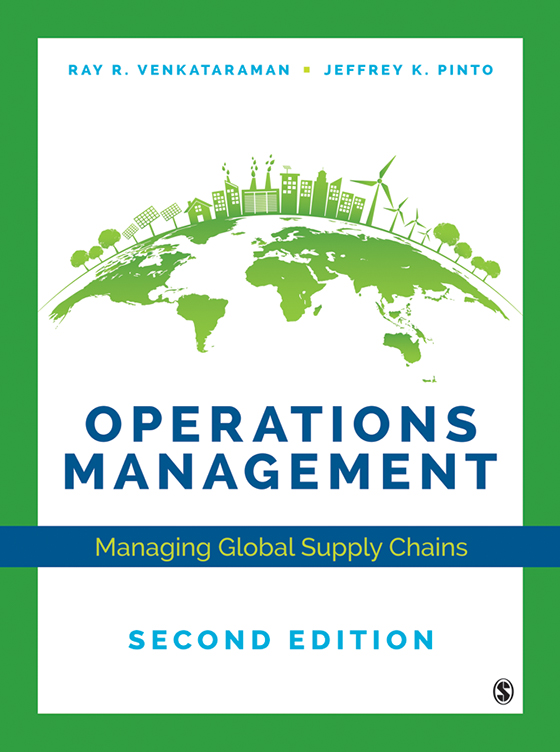

Operations Management
Managing Global Supply Chains
January 2019 | 1152 pages | Sage US
| Format | Published Date | ISBN | Price |
|---|
Operations Management: Managing Global Supply Chains takes a holistic, integrated approach to managing operations and supply chains by exploring the strategic, tactical, and operational decisions and challenges facing organizations worldwide. Authors Ray R. Venkataraman and Jeffrey K. Pinto address sustainability in each chapter, showing that sustainable operations and supply chain practices are not only attainable, but are critical and often profitable practices for organizations to undertake. With a focus on critical thinking and problem solving, Operations Management provides students with a comprehensive introduction to the field and equips them with the tools necessary to thrive in today’s evolving global business environment.
A Complete Teaching & Learning Package
SAGE coursepacks
FREE! Easily import our quality instructor and student resource content into your school’s learning management system (LMS) and save time. Learn more.
SAGE edge
FREE online resources for students that make learning easier. See how your students benefit.
A Complete Teaching & Learning Package
SAGE coursepacks
FREE! Easily import our quality instructor and student resource content into your school’s learning management system (LMS) and save time. Learn more.
SAGE edge
FREE online resources for students that make learning easier. See how your students benefit.
Table Of Contents:
- Preface
- Acknowledgments
- About the Authors
- PART I: INTRODUCTION
- Chapter 1: Introduction to Managing Global Operations and Supply Chains
- 1.1 Supply Chains and Operations Management in the Global Economy
- 1.2 What Does Operations Management Entail?
- 1.3 What Does Supply Chain Management Entail?
- 1.4 An Integrated Perspective on Operations and Supply Chain Management
- 1.5 The Evolution of Operations and Supply Chain Management
- 1.6 Current and Emerging Issues in Operations and Supply Chain Management
- 1.7 Road Map: How This Text Is Organized
- Chapter Summary
- Key Terms
- Discussion and Review Questions
- Problems
- Case Study 1.1 Multinational Companies and China: Investing for the Long Term
- Case Study 1.2 Nintendo’s Wii and Wii U: Absence Makes the Heart Grow Fonder
- Video Case
- Critical Thinking Exercise
- PART II: STRATEGIC DECISIONS
- Chapter 2: Operations and Supply Chain Strategies
- 2.1 Levels of Strategic Planning
- 2.2 Formulating and Evaluating Operations Strategies
- 2.3 Formulating and Evaluating Strategies for Service Organizations
- 2.4 Measuring Productivity as Part of Strategic Planning
- 2.5 Strategies for Supply Chains
- 2.6 Global Strategies
- 2.7 Sustainability Issues
- Chapter Summary
- Key Terms
- Discussion and Review Questions
- Solved Problems
- Problems
- Case Study 2.1 Supply Chain Strategies and Disaster Planning
- Video Case
- Critical Thinking Exercise
- Chapter 3: Project Management
- 3.1 Projects, Project Teams, and Measuring Success
- 3.2 Project Life Cycles
- 3.3 Conceptualizing and Planning Projects
- 3.4 Scheduling Projects
- 3.5 Supply Chains for Projects
- 3.6 Executing, Evaluating, and Terminating Projects
- 3.7 Sustainability Issues
- 3.8 Global Projects
- Chapter Summary
- Key Terms
- Discussion and Review Questions
- Solved Problems
- Problems
- Case Study 3.1 Project Management in the Movie Business
- Video Case
- Critical Thinking Exercise
- Supplement for Chapter 3: Project Management
- 3S.1 Determining the Probability of a Project Being Completed on Time
- 3S.2 Calculating the Time-Cost Trade-Offs of Crashing a Project
- 3S.3 Calculating a Project’s Earned Value
- Supplement Summary
- Key Terms
- Discussion and Review Questions
- Solved Problems
- Problems
- Critical Thinking Exercise
- Chapter 4: Product and Service Innovations
- 4.1 Why Companies Develop New Products and Services
- 4.2 How New Products Are Developed
- 4.3 New Product Development Concepts and Strategies
- 4.4 Using Technology to Develop New Products
- 4.5 Global Product Development
- 4.6 New Product Development Issues for Supply Chains
- 4.7 How Services Are Designed
- 4.8 Legal, Ethical, and Sustainability Issues
- Chapter Summary
- Key Terms
- Discussion and Review Questions
- Problems
- Case Study 4.1 Redesigning for Efficiency: The Chevrolet Malibu
- Video Case
- Critical Thinking Exercise
- Supplement for Chapter 4: Reliability
- 4S.1 Understanding Reliability
- 4S.2 Availability and Maintainability
- Supplement Summary
- Key Terms
- Discussion and Review Questions
- Solved Problems
- Problems
- Chapter 5: Managing for Quality
- 5.1 Defining Quality
- 5.2 The Benefits and Costs of Managing Quality
- 5.3 The Evolution of Quality Management and Its Pioneers
- 5.4 Major Quality Management Initiatives
- 5.5 Quality Management Tools and Techniques
- 5.6 Managing Quality for Supply Chains
- 5.7 Global Quality Management
- 5.8 Legal, Ethical, and Sustainability Issues,
- Chapter Summary
- Key Terms
- Discussion and Review Questions
- Problems
- Case Study 5.1 Pfizer Fixes Problems With Its Cleaning Processes
- Case Study 5.2 Partnering to Improve Quality
- Case Study 5.3 3M: Finding the Delicate Balance Between Six Sigma and Innovation
- Case Study 5.4 Van Halen, Brown M&Ms, and Quality Control
- Video Case
- Critical Thinking Exercise
- Chapter 6: Quality Improvement and Control Tools
- 6.1 Quality Control Versus Quality Assurance
- 6.2 Quality Appraisal Tools
- 6.3 Quality Defect Prevention Tools
- 6.4 Quality Design Tools
- Chapter Summary
- Key Terms
- Discussion and Review Questions
- Solved Problems
- Problems
- Case Study 6.1 J.D. Power Automobile Surveys: What Does “Quality” Mean, Anyway?
- Video Case
- Critical Thinking Exercises
- Chapter 7: Capacity Planning
- 7.1 Capacity Planning
- 7.2 Service Capacity Planning
- 7.3 Capacity Planning for Supply Chains
- 7.4 Ethical and Sustainability Issues
- 7.5 Global Capacity Management
- Chapter Summary
- Key Terms
- Discussion and Review Questions
- Solved Problems
- Problems
- Case Study 7.1 Kirwain’s Capacity Planning Challenge
- Video Cases
- Critical Thinking Exercises
- Chapter 8: Supply Chain Design and Location Planning
- 8.1 Supply Chain Design and Facility Location Decisions
- 8.2 Phases in the Supply Chain Design and Location Decision-Making Process
- 8.3 Analytical Methods for Evaluating Locations
- 8.4 Ethical and Sustainability Issues
- 8.5 Global Location Planning
- Chapter Summary
- Key Terms
- Discussion and Review Questions
- Problems
- Case Study 8.1 Countering the Counterfeiters
- Case Study 8.2 Alpharetta Tools
- Video Case
- Critical Thinking Exercise
- Chapter 9: Process Design and Layout Planning
- 9.1 Designing, Selecting, and Redesigning Manufacturing Processes
- 9.2 Designing Service Processes
- 9.3 Designing Processes for Supply Chains
- 9.4 Global Process Design
- 9.5 Layout Planning
- 9.6 Legal, Ethical, and Sustainability Issues
- Chapter Summary
- Key Terms
- Discussion and Review Questions
- Problems
- Case Study 9.1 Challenges of Redesigning a Plant Layout
- Video Case
- Critical Thinking Exercise
- Supplement for Chapter 9: Tools for Analyzing, Designing, and Selecting Processes and Layouts
- 9S.1 Process Selection, Design, and Analysis Tools
- 9S.2 Layout Analysis Tools and Techniques
- Supplement Summary
- Key Terms
- Discussion and Review Questions
- Solved Problems
- Problems
- Critical Thinking Exercises
- PART III: INTEGRATIVE DECISIONS
- Chapter 10: Supplier Management
- 10.1 Supplier Management and Its Goals
- 10.2 The Supplier Management Process
- 10.3 Managing Service Providers
- 10.4 Global Supplier Management
- 10.5 Legal, Ethical, and Sustainability Issues
- Chapter Summary
- Key Terms
- Discussion and Review Questions
- Solved Problem
- Problems
- Case Study 10.1 The Boeing
- Video Cases
- Critical Thinking Exercise
- Chapter 11: Logistics Management
- 11.1 Integrated Logistics Management
- 11.2 Order Fulfillment
- 11.3 Transportation Management
- 11.4 Packaging
- 11.5 Materials Handling
- 11.6 Warehousing Management
- 11.7 Inventory Management
- 11.8 Facilities Network Design,
- 11.9 Global Logistics
- 11.10 Logistics Outsourcing
- 11.11 Logistics in the Service Sector
- 11.12 Ethical and Sustainability Issues
- Chapter Summary
- Key Terms
- Discussion and Review Questions
- Problems
- Case Study 11.1 How Sustainable Logistics Solutions and Technologies Have Helped Walmart Become More Efficient
- Case Study 11.2 Third-Party Logistics and the Mistreatment of Workers
- Video Case
- Critical Thinking Exercises
- Chapter 12: Demand Management and Customer Service
- 12.1 Demand Management
- 12.2 Global Demand Management
- 12.3 Services Demand Management
- 12.4 Customer Service and Demand Management
- 12.5 Ethical and Sustainability Issues
- Chapter Summary
- Key Terms
- Discussion and Review Questions
- Problems
- Case Study 12.1 McDonald’s Reinvents Itself, Again
- Case Study 12.2 Predicting the Future Demand for Rural Health Care
- Video Cases
- Critical Thinking Exercises
- Chapter 13: Demand Forecasting Methods
- 13.1 Introduction to Forecasting and Its Applications
- 13.2 The Characteristics of Good Forecasts
- 13.3 Qualitative Versus Quantitative Forecasting Methods
- 13.4 Measuring and Monitoring the Accuracy of Forecasting Methods
- 13.5 Monitoring and Controlling Forecasts
- 13.6 Forecasting for Supply Chains
- 13.7 Ethical Issues
- Chapter Summary
- Key Terms
- Discussion and Review Questions
- Solved Problems
- Problems
- Case Study 13.1 Forecasting Ticket Demand for the Super Bowl
- Case Study 13.2 Ethical Forecasting: If You Torture the Numbers Long Enough, They Can Tell You Anything!
- Video Cases
- Critical Thinking Exercises
- PART IV: TACTICAL DECISIONS
- Chapter 14: Lean Operations and Supply Chains
- 14.1 Introduction to Lean Operations
- 14.2 The Philosophy of Lean Systems
- 14.3 Elements of Lean Systems
- 14.4 Lean Services
- 14.5 Lean Supply Chains
- 14.6 Lean Global Supply Chains
- 14.7 Sustainability Issues
- Chapter Summary
- Key Terms
- Discussion and Review Questions
- Solved Problem
- Problems
- Case Study 14.1 Lean Sustainable Supply Chains at Unilever
- Case Study 14.2 TAL Apparel and JCPenney
- Critical Thinking Exercise
- Appendix 14.1: Value Stream Mapping Symbols
- Appendix 14.2: Steps for Developing a Value Stream Map
- Chapter 15: Inventory Management
- 15.1 Types of Inventory
- 15.2 Inventory Costs
- 15.3 Inventory Considerations for Supply Chains
- 15.4 Inventory Management Measures
- 15.5 Key Features of Effective Inventory Management Systems
- 15.6 Uncertainty in Supply Chain Inventories: The Bullwhip Effect
- 15.7 Ethical and Sustainability Issues
- 15.8 Global Inventory Management
- 15.9 Service Sector Inventory Management
- Chapter Summary
- Key Terms
- Discussion and Review Questions
- Solved Problem
- Problems
- Case Study 15.1 Inventory Pressures Cause Tuesday Morning to Abandon e-Commerce
- Case Study 15.2 Inventory Management in the Age of the Online Shopper
- Video Case
- Critical Thinking Exercises
- Chapter 16: Inventory Control Models
- 16.1 How Much to Order: Continuous Review Systems
- 16.2 Economic Production Quantity (EPQ) Model
- 16.3 EOQ Model with Quantity Discounts
- 16.4 When to Order: Reorder Point for Continuous Review Systems (EOQ Model)
- 16.5 How Much to Order: Periodic Review Systems
- 16.6 How Much to Order: Single-Period Inventory Systems
- Chapter Summary
- Key Terms
- Discussion and Review Questions
- Solved Problems
- Problems
- Case Study 16.1 When Your Customers Steer You Wrong: Walmart’s Project Impact Disaster
- Video Case
- Critical Thinking Exercise
- Chapter 17: Sales and Operations Planning
- 17.1 The Basics of Sales and Operations Planning
- 17.2 Benefits of Sales and Operations Planning
- 17.3 Framework of the Sales and Operations Planning Process
- 17.4 Options for Influencing Demand and Supply in Sales and Operations Planning
- 17.5 Sales and Operations Planning Strategies
- 17.6 Methods for Sales and Operations Planning
- 17.7 Sales and Operations Planning for Supply Chains
- 17.8 Sales and Operations Planning in Service Industries
- 17.9 Sustainable S&OP: Sales Carbon Operations Planning (SCOP)
- 17.10 Ethical Issues
- Chapter Summary
- Key Terms
- Discussion and Review Questions
- Solved Problem
- Problems
- Case Study 17.1: Coordinating Sales and Operations Planning for the Next Big Thing: The Case of the Sony PS4 Launch
- Video Case
- Critical Thinking Exercise
- PART V: OPERATIONAL DECISIONS
- Chapter 18: Master Scheduling and Material Requirements Planning
- 18.1 Master Scheduling
- 18.2 Material Requirements Planning
- 18.3 Ethical and Sustainability Issues
- Chapter Summary
- Key Terms
- Discussion and Review Questions
- Solved Problems
- Problems
- Case Study 18.1 Bringing Order to a Chaotic Restaurant
- Video Case
- Critical Thinking Exercise
- Supplement for Chapter 18: Capacity Requirements Planning, MRP II, ERP, and DRP
- 18S.1 Capacity Requirements Planning (CRP)
- 18S.2 Manufacturing Resource Planning (MRP II)—An Extension of MRP
- 18S.3 Enterprise Resource Planning (ERP)
- 18S.4 Impact of MRP, MRP II, and ERP on Supply Chains
- 18S.5 Distribution Requirements Planning (DRP)
- 18S.6 Sustainability Issues
- Supplement Summary
- Key Terms
- Discussion and Review Questions
- Solved Problem
- Problems
- Case Study 18S.1 Thinking Outside the Box: Enterprise Training at General Mills
- Critical Thinking Exercise
- Chapter 19: Detailed Scheduling
- 19.1 What Detailed Scheduling Is
- 19.2 Types of Scheduling for Manufacturers
- 19.3 Why Scheduling Is Complex
- 19.4 Scheduling in the Service Sector
- 19.5 Scheduling for Supply Chains
- 19.6 Ethical and Sustainability Issues
- Chapter Summary
- Key Terms
- Discussion and Review Questions
- Solved Problems
- Problems
- Case Study 19.1 Telling Umpires Where to Go!
- Video Case
- Critical Thinking Exercises
- PART VI: QUANTITATIVE MODULES
- Module A: Linear Programming
- Introduction
- A.1 Features of a Linear Programming (LP) Problem
- A.2 Solving Linear Programming Problems Using Excel
- A.3 Sensitivity Analysis
- A.4 Additional Linear Programming Models
- Module Summary
- Key Terms
- Discussion and Review Questions
- Solved Problems
- Problems
- Case Study A.1 Happy Hour, Happy Profits
- Module B: The Transportation Models
- B.1 Formulating and Solving the Transportation Problem
- B.2 Additional Issues in Transportation Modeling
- Module Summary
- Key Terms
- Discussion and Review Questions
- Solved Problems
- Problems
- Case Study B.1 Plant Location for Tru-Blade Ski Company
- Module C: Waiting Line Models
- C.1 Introduction to Waiting Line Models
- C.2 Queueing Models
- Module Summary
- Key Terms
- Discussion and Review Questions
- Solved Problems
- Problems
- Case Study C.1 The Psychology of Waiting in Lines
- Questions for Discussion
- Module D: Simulation
- D.1 Introduction to Simulation
- D.2 Monte Carlo Simulation
- Module Summary
- Key Terms
- Discussion and Review Questions
- Solved Problem
- Problems
- Case Study D.1 Staying Ahead of the Demand for Ice Cream
- Module E: Learning Curves
- E.1 What Are Learning Curves?
- E.2 Applications of Learning Curves
- E.3 Approaches to Solving Learning Curve Problems
- E.4 Learning Curves in Cost Estimation
- E.5 Limitations of Learning Curves
- Module Summary
- Key Terms
- Discussion and Review Questions
- Solved Problems
- Problems
- Case Study E.1 Estimating the Cost of a Drilling Platform
- Module F: Decision-Making Tools
- F.1 Using a Systematic Decision-Making Process
- F.2 Elements in the Decision-Making Process
- F.3 Categorizing Decisions
- F.4 Techniques for Making Decisions Under Certainty, Uncertainty, and Risk
- F.5 Techniques for Making Sequential Decisions
- Module Summary
- Key Terms
- Discussion and Review Questions
- Solved Problems
- Problems
- Case Study F.1 Gerber Products Company: The Problem
- Case Study F.2 Gerber Products Company: The Solution
- Appendix A: Tables
- Appendix B: Answers to Select Problems
- Glossary
- Notes
- Company Index
- Subject Index