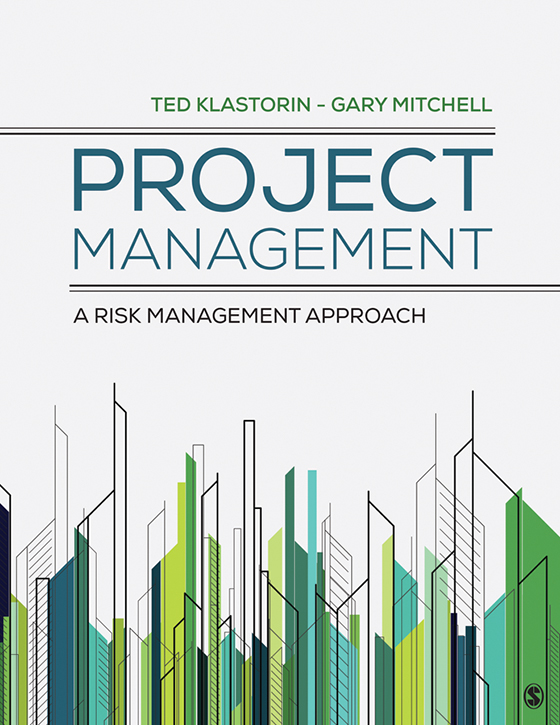
Project Management
A Risk-Management Approach
First Edition
Ted Klastorin
- University of Washington, USA
Gary Mitchell
- University of Portland, USA

If you’re in the Americas, please visit our Sage College Publishing website to purchase or sample this book:
Go to College Publishing WebsiteDescription
As the number and size of projects continue to increase, there is a growing demand for effective project managers. Project Management: A Risk-Management Approach prepares students to successfully navigate the many challenges, factors, and situations that project managers face. Authors Ted Klastorin and Gary Mitchell emphasize the importance of mitigating risk at every stage, helping students avoid common pitfalls that lead to project failures, compromised schedules, or incurred costs. Real-world examples, cases, solved problems, and practice problems help bring methodologies to life. Readers will be equipped with the tools they need to plan, schedule, and monitor even the most complex projects in a variety of market sectors.
Included with this title:
The password-protected Instructor Resource Site (formally known as Sage Edge) offers access to all text-specific resources, including a test bank and editable, chapter-specific PowerPoint® slides. Learn more.
Included with this title:
The password-protected Instructor Resource Site (formally known as Sage Edge) offers access to all text-specific resources, including a test bank and editable, chapter-specific PowerPoint® slides. Learn more.
Contents
Foreword
Foreword
Preface
Preface
Acknowledgments
Acknowledgments
About the Authors
- Chapter 1. An Introduction to Project Management
- 1.1 Introduction
- 1.2 What Defines a Project?
- 1.3 The Project Life Cycle
- 1.4 Measures of Project Success and Failure
- 1.5 Managing Project Risks
- 1.6 Project Management Trade-Offs
- 1.7 Program Versus Project Management
- 1.8 Agile Project Management: A Modern Development
- 1.9 A Brief History of Project Management
- 1.10 Overview of the Text
- Chapter 2. Project Initiation and Selection
- 2.1 Introduction
- 2.2 The Relationship of Projects to Strategic and Operational Goals
- 2.3 Simple Numerical Measures
- 2.4 Advanced Measures
- 2.5 Implementing “Options Thinking”
- 2.6 “Stage Gates” Defined
- 2.7 Ranking and Scoring Methods
- 2.8 Evaluating Project Portfolios
- Summary
- Chapter 3. Project Planning
- 3.1 Introduction
- 3.2 Outline of a Project Plan
- 3.3 Risk Management Strategy and Plan
- 3.4 Communications Strategy and Plan
- 3.5 Identifying Project Requirements
- Summary
- Chapter 3S. Supplement: Agile Project Management
- 3S.1 Introduction
- 3S.2 Agile Project Management
- 3S.3 Implementing Agile PM
- 3S.4 Scrum and Extreme Programming
- 3S.5 Velocity and Burndown Charts
- 3S.6 Risk Management and the Agile–Traditional Continuum
- 3S.7 Agile PM Analogy: American Football
- Summary
- Chapter 4. Defining Project Content
- 4.1 Introduction
- 4.2 Costs Defined
- 4.3 Defining Project Work
- 4.4 Estimating Work Content and Task Duration
- 4.5 Deterministic Versus Stochastic Estimates
- 4.6 Common Pitfalls and Perils
- Summary
- Chapter 4S. Supplement: Review of Probability and Distribution Functions
- 4S.1 Introduction
- 4S.2 Probability Distributions
- 4S.3 Summary Measures for Probability Distributions
- 4S.4 Common Discrete Distributions
- 4S.5 Common Continuous Distributions
- 4S.6 Sums of Random Variables
- Summary
- Chapter 5. Scheduling a Deterministic Project
- 5.1 Introduction
- 5.2 Determining a Project’s Schedule
- 5.3 The Critical Path Method
- 5.4 Calculating Slacks (Floats)
- 5.5 Types of Precedence Relations
- 5.6 Linear Programming Formulation
- 5.7 Gantt Charts: Representing the Schedule Graphically
- 5.8 Activity-on-Arc Precedence Networks
- 5.9 A Note Regarding Software Programs
- Summary
- Chapter 6. Project Trade-Offs and Risk Mitigation
- 6.1 Introduction
- 6.2 Preparing a Budget: The Basic Time–Cost Relationship
- 6.3 Project Compression: Time–Cost Trade-Offs
- 6.4 Risk Management and Time–Cost Trade-Offs
- 6.5 Time–Cost Trade-Offs in Stochastic Projects
- 6.6 Other Trade-Off Issues: Concurrent Engineering and Coordination Costs
- Summary
- Chapter 7. Scheduling Stochastic Projects
- 7.1 Introduction
- 7.2 Proactive Versus Reactive Scheduling
- 7.3 Using Buffers to Protect the Schedule
- 7.4 Planning Under Task Time Uncertainty Using Classic PERT
- 7.5 Planning Under Task Time Uncertainty Using Monte Carlo Simulation Models
- 7.6 Managing Exogenous Uncertainties
- 7.7 Task Time Uncertainty and the Theory of Constraints
- Summary
- Chapter 7S. Supplement: Monte Carlo Simulation
- 7S.1 Introduction
- 7S.2 The Basic Concept
- 7S.3 Generating Random Variates
- 7S.4 Generate Trials
- 7S.5 Analyzing the Simulation
- Summary
- Chapter 8. Managing Project Resources
- 8.1 Introduction
- 8.2 Defining Resource Types
- 8.3 Criteria for Scheduling Resource Types
- 8.4 The Resource Leveling Problem Defined
- 8.5 The Rate-Constrained Resource Allocation Problem
- 8.6 Heuristics for the Rate-Constrained Resource Allocation Problem
- 8.7 An Easily Solvable Rate-Constrained Resource Allocation Problem: The Critical Chain Defined
- 8.8 The Critical Chain Methodology
- 8.9 Defining Resource Buffers
- 8.10 Capacity-Constrained Resource Allocation
- 8.11 Supply Chain Management and Projects
- 8.12 Impact of Worker Behaviors on Project Outcomes
- Summary
- Chapter 9. Project Teams
- 9.1 Introduction
- 9.2 Forming a Project Team
- 9.3 Assigning Potential Team Members to a Project
- 9.4 Making Trade-Off Decisions When Creating Project Teams
- 9.5 Determining Team Size When Resource Availability Is Uncertain
- 9.6 Managing the Project Team
- 9.7 Managing the End of Project Transition
- Summary
- Chapter 10. Managing Decentralized Projects
- 10.1 Introduction
- 10.2 Decentralized Projects
- 10.3 Subcontracting Issues Defined
- 10.4 Underlying Economic Concepts
- 10.5 Contract Types Defined
- 10.6 Defining a Contract That Maximizes the Project Value
- Summary
- Chapter 11. Assessing Project Progress
- 11.1 Introduction
- 11.2 Assessing In-Control Versus Out-of-Control Project States
- 11.3 Earned Value Analysis Defined
- 11.4 Limitations of Earned Value Analysis
- 11.5 Updating Cost and Schedule Forecasts
- Summary
- Chapter 12. Managing a Multiproject Environment
- 12.1 Introduction
- 12.2 Managing the Project Portfolio
- 12.3 Ensuring Projects Deliver Their Value Propositions
- 12.4 The Role of the Project Manager
- 12.5 The Role of the PMO
- Summary
Appendix A: Textbook Notations Defined
Appendix A: Textbook Notations Defined
Appendix B: MS Project Practice Problems
Appendix B: MS Project Practice Problems
Glossary
Glossary
Bibliography
Bibliography
Index
Index
Description
As the number and size of projects continue to increase, there is a growing demand for effective project managers. Project Management: A Risk-Management Approach prepares students to successfully navigate the many challenges, factors, and situations that project managers face. Authors Ted Klastorin and Gary Mitchell emphasize the importance of mitigating risk at every stage, helping students avoid common pitfalls that lead to project failures, compromised schedules, or incurred costs. Real-world examples, cases, solved problems, and practice problems help bring methodologies to life. Readers will be equipped with the tools they need to plan, schedule, and monitor even the most complex projects in a variety of market sectors.
Included with this title:
The password-protected Instructor Resource Site (formally known as Sage Edge) offers access to all text-specific resources, including a test bank and editable, chapter-specific PowerPoint® slides. Learn more.
Included with this title:
The password-protected Instructor Resource Site (formally known as Sage Edge) offers access to all text-specific resources, including a test bank and editable, chapter-specific PowerPoint® slides. Learn more.
Contents
Foreword
Foreword
Preface
Preface
Acknowledgments
Acknowledgments
About the Authors
- Chapter 1. An Introduction to Project Management
- 1.1 Introduction
- 1.2 What Defines a Project?
- 1.3 The Project Life Cycle
- 1.4 Measures of Project Success and Failure
- 1.5 Managing Project Risks
- 1.6 Project Management Trade-Offs
- 1.7 Program Versus Project Management
- 1.8 Agile Project Management: A Modern Development
- 1.9 A Brief History of Project Management
- 1.10 Overview of the Text
- Chapter 2. Project Initiation and Selection
- 2.1 Introduction
- 2.2 The Relationship of Projects to Strategic and Operational Goals
- 2.3 Simple Numerical Measures
- 2.4 Advanced Measures
- 2.5 Implementing “Options Thinking”
- 2.6 “Stage Gates” Defined
- 2.7 Ranking and Scoring Methods
- 2.8 Evaluating Project Portfolios
- Summary
- Chapter 3. Project Planning
- 3.1 Introduction
- 3.2 Outline of a Project Plan
- 3.3 Risk Management Strategy and Plan
- 3.4 Communications Strategy and Plan
- 3.5 Identifying Project Requirements
- Summary
- Chapter 3S. Supplement: Agile Project Management
- 3S.1 Introduction
- 3S.2 Agile Project Management
- 3S.3 Implementing Agile PM
- 3S.4 Scrum and Extreme Programming
- 3S.5 Velocity and Burndown Charts
- 3S.6 Risk Management and the Agile–Traditional Continuum
- 3S.7 Agile PM Analogy: American Football
- Summary
- Chapter 4. Defining Project Content
- 4.1 Introduction
- 4.2 Costs Defined
- 4.3 Defining Project Work
- 4.4 Estimating Work Content and Task Duration
- 4.5 Deterministic Versus Stochastic Estimates
- 4.6 Common Pitfalls and Perils
- Summary
- Chapter 4S. Supplement: Review of Probability and Distribution Functions
- 4S.1 Introduction
- 4S.2 Probability Distributions
- 4S.3 Summary Measures for Probability Distributions
- 4S.4 Common Discrete Distributions
- 4S.5 Common Continuous Distributions
- 4S.6 Sums of Random Variables
- Summary
- Chapter 5. Scheduling a Deterministic Project
- 5.1 Introduction
- 5.2 Determining a Project’s Schedule
- 5.3 The Critical Path Method
- 5.4 Calculating Slacks (Floats)
- 5.5 Types of Precedence Relations
- 5.6 Linear Programming Formulation
- 5.7 Gantt Charts: Representing the Schedule Graphically
- 5.8 Activity-on-Arc Precedence Networks
- 5.9 A Note Regarding Software Programs
- Summary
- Chapter 6. Project Trade-Offs and Risk Mitigation
- 6.1 Introduction
- 6.2 Preparing a Budget: The Basic Time–Cost Relationship
- 6.3 Project Compression: Time–Cost Trade-Offs
- 6.4 Risk Management and Time–Cost Trade-Offs
- 6.5 Time–Cost Trade-Offs in Stochastic Projects
- 6.6 Other Trade-Off Issues: Concurrent Engineering and Coordination Costs
- Summary
- Chapter 7. Scheduling Stochastic Projects
- 7.1 Introduction
- 7.2 Proactive Versus Reactive Scheduling
- 7.3 Using Buffers to Protect the Schedule
- 7.4 Planning Under Task Time Uncertainty Using Classic PERT
- 7.5 Planning Under Task Time Uncertainty Using Monte Carlo Simulation Models
- 7.6 Managing Exogenous Uncertainties
- 7.7 Task Time Uncertainty and the Theory of Constraints
- Summary
- Chapter 7S. Supplement: Monte Carlo Simulation
- 7S.1 Introduction
- 7S.2 The Basic Concept
- 7S.3 Generating Random Variates
- 7S.4 Generate Trials
- 7S.5 Analyzing the Simulation
- Summary
- Chapter 8. Managing Project Resources
- 8.1 Introduction
- 8.2 Defining Resource Types
- 8.3 Criteria for Scheduling Resource Types
- 8.4 The Resource Leveling Problem Defined
- 8.5 The Rate-Constrained Resource Allocation Problem
- 8.6 Heuristics for the Rate-Constrained Resource Allocation Problem
- 8.7 An Easily Solvable Rate-Constrained Resource Allocation Problem: The Critical Chain Defined
- 8.8 The Critical Chain Methodology
- 8.9 Defining Resource Buffers
- 8.10 Capacity-Constrained Resource Allocation
- 8.11 Supply Chain Management and Projects
- 8.12 Impact of Worker Behaviors on Project Outcomes
- Summary
- Chapter 9. Project Teams
- 9.1 Introduction
- 9.2 Forming a Project Team
- 9.3 Assigning Potential Team Members to a Project
- 9.4 Making Trade-Off Decisions When Creating Project Teams
- 9.5 Determining Team Size When Resource Availability Is Uncertain
- 9.6 Managing the Project Team
- 9.7 Managing the End of Project Transition
- Summary
- Chapter 10. Managing Decentralized Projects
- 10.1 Introduction
- 10.2 Decentralized Projects
- 10.3 Subcontracting Issues Defined
- 10.4 Underlying Economic Concepts
- 10.5 Contract Types Defined
- 10.6 Defining a Contract That Maximizes the Project Value
- Summary
- Chapter 11. Assessing Project Progress
- 11.1 Introduction
- 11.2 Assessing In-Control Versus Out-of-Control Project States
- 11.3 Earned Value Analysis Defined
- 11.4 Limitations of Earned Value Analysis
- 11.5 Updating Cost and Schedule Forecasts
- Summary
- Chapter 12. Managing a Multiproject Environment
- 12.1 Introduction
- 12.2 Managing the Project Portfolio
- 12.3 Ensuring Projects Deliver Their Value Propositions
- 12.4 The Role of the Project Manager
- 12.5 The Role of the PMO
- Summary
Appendix A: Textbook Notations Defined
Appendix A: Textbook Notations Defined
Appendix B: MS Project Practice Problems
Appendix B: MS Project Practice Problems
Glossary
Glossary
Bibliography
Bibliography
Index
Index
Reviews

August 2020 | 712 pages | Sage US
| Format | Published Date | ISBN | Price |
|---|
As the number and size of projects continue to increase, there is a growing demand for effective project managers. Project Management: A Risk-Management Approach prepares students to successfully navigate the many challenges, factors, and situations that project managers face. Authors Ted Klastorin and Gary Mitchell emphasize the importance of mitigating risk at every stage, helping students avoid common pitfalls that lead to project failures, compromised schedules, or incurred costs. Real-world examples, cases, solved problems, and practice problems help bring methodologies to life. Readers will be equipped with the tools they need to plan, schedule, and monitor even the most complex projects in a variety of market sectors.
Included with this title:
The password-protected Instructor Resource Site (formally known as Sage Edge) offers access to all text-specific resources, including a test bank and editable, chapter-specific PowerPoint® slides. Learn more.
Included with this title:
The password-protected Instructor Resource Site (formally known as Sage Edge) offers access to all text-specific resources, including a test bank and editable, chapter-specific PowerPoint® slides. Learn more.
Table Of Contents:
- Foreword
- Preface
- Acknowledgments
- About the Authors
- Chapter 1. An Introduction to Project Management
- 1.1 Introduction
- 1.2 What Defines a Project?
- 1.3 The Project Life Cycle
- 1.4 Measures of Project Success and Failure
- 1.5 Managing Project Risks
- 1.6 Project Management Trade-Offs
- 1.7 Program Versus Project Management
- 1.8 Agile Project Management: A Modern Development
- 1.9 A Brief History of Project Management
- 1.10 Overview of the Text
- Chapter 2. Project Initiation and Selection
- 2.1 Introduction
- 2.2 The Relationship of Projects to Strategic and Operational Goals
- 2.3 Simple Numerical Measures
- 2.4 Advanced Measures
- 2.5 Implementing “Options Thinking”
- 2.6 “Stage Gates” Defined
- 2.7 Ranking and Scoring Methods
- 2.8 Evaluating Project Portfolios
- Summary
- Chapter 3. Project Planning
- 3.1 Introduction
- 3.2 Outline of a Project Plan
- 3.3 Risk Management Strategy and Plan
- 3.4 Communications Strategy and Plan
- 3.5 Identifying Project Requirements
- Summary
- Chapter 3S. Supplement: Agile Project Management
- 3S.1 Introduction
- 3S.2 Agile Project Management
- 3S.3 Implementing Agile PM
- 3S.4 Scrum and Extreme Programming
- 3S.5 Velocity and Burndown Charts
- 3S.6 Risk Management and the Agile–Traditional Continuum
- 3S.7 Agile PM Analogy: American Football
- Summary
- Chapter 4. Defining Project Content
- 4.1 Introduction
- 4.2 Costs Defined
- 4.3 Defining Project Work
- 4.4 Estimating Work Content and Task Duration
- 4.5 Deterministic Versus Stochastic Estimates
- 4.6 Common Pitfalls and Perils
- Summary
- Chapter 4S. Supplement: Review of Probability and Distribution Functions
- 4S.1 Introduction
- 4S.2 Probability Distributions
- 4S.3 Summary Measures for Probability Distributions
- 4S.4 Common Discrete Distributions
- 4S.5 Common Continuous Distributions
- 4S.6 Sums of Random Variables
- Summary
- Chapter 5. Scheduling a Deterministic Project
- 5.1 Introduction
- 5.2 Determining a Project’s Schedule
- 5.3 The Critical Path Method
- 5.4 Calculating Slacks (Floats)
- 5.5 Types of Precedence Relations
- 5.6 Linear Programming Formulation
- 5.7 Gantt Charts: Representing the Schedule Graphically
- 5.8 Activity-on-Arc Precedence Networks
- 5.9 A Note Regarding Software Programs
- Summary
- Chapter 6. Project Trade-Offs and Risk Mitigation
- 6.1 Introduction
- 6.2 Preparing a Budget: The Basic Time–Cost Relationship
- 6.3 Project Compression: Time–Cost Trade-Offs
- 6.4 Risk Management and Time–Cost Trade-Offs
- 6.5 Time–Cost Trade-Offs in Stochastic Projects
- 6.6 Other Trade-Off Issues: Concurrent Engineering and Coordination Costs
- Summary
- Chapter 7. Scheduling Stochastic Projects
- 7.1 Introduction
- 7.2 Proactive Versus Reactive Scheduling
- 7.3 Using Buffers to Protect the Schedule
- 7.4 Planning Under Task Time Uncertainty Using Classic PERT
- 7.5 Planning Under Task Time Uncertainty Using Monte Carlo Simulation Models
- 7.6 Managing Exogenous Uncertainties
- 7.7 Task Time Uncertainty and the Theory of Constraints
- Summary
- Chapter 7S. Supplement: Monte Carlo Simulation
- 7S.1 Introduction
- 7S.2 The Basic Concept
- 7S.3 Generating Random Variates
- 7S.4 Generate Trials
- 7S.5 Analyzing the Simulation
- Summary
- Chapter 8. Managing Project Resources
- 8.1 Introduction
- 8.2 Defining Resource Types
- 8.3 Criteria for Scheduling Resource Types
- 8.4 The Resource Leveling Problem Defined
- 8.5 The Rate-Constrained Resource Allocation Problem
- 8.6 Heuristics for the Rate-Constrained Resource Allocation Problem
- 8.7 An Easily Solvable Rate-Constrained Resource Allocation Problem: The Critical Chain Defined
- 8.8 The Critical Chain Methodology
- 8.9 Defining Resource Buffers
- 8.10 Capacity-Constrained Resource Allocation
- 8.11 Supply Chain Management and Projects
- 8.12 Impact of Worker Behaviors on Project Outcomes
- Summary
- Chapter 9. Project Teams
- 9.1 Introduction
- 9.2 Forming a Project Team
- 9.3 Assigning Potential Team Members to a Project
- 9.4 Making Trade-Off Decisions When Creating Project Teams
- 9.5 Determining Team Size When Resource Availability Is Uncertain
- 9.6 Managing the Project Team
- 9.7 Managing the End of Project Transition
- Summary
- Chapter 10. Managing Decentralized Projects
- 10.1 Introduction
- 10.2 Decentralized Projects
- 10.3 Subcontracting Issues Defined
- 10.4 Underlying Economic Concepts
- 10.5 Contract Types Defined
- 10.6 Defining a Contract That Maximizes the Project Value
- Summary
- Chapter 11. Assessing Project Progress
- 11.1 Introduction
- 11.2 Assessing In-Control Versus Out-of-Control Project States
- 11.3 Earned Value Analysis Defined
- 11.4 Limitations of Earned Value Analysis
- 11.5 Updating Cost and Schedule Forecasts
- Summary
- Chapter 12. Managing a Multiproject Environment
- 12.1 Introduction
- 12.2 Managing the Project Portfolio
- 12.3 Ensuring Projects Deliver Their Value Propositions
- 12.4 The Role of the Project Manager
- 12.5 The Role of the PMO
- Summary
- Appendix A: Textbook Notations Defined
- Appendix B: MS Project Practice Problems
- Glossary
- Bibliography
- Index
Recent Product Reviews:
MSc Engineering students on project management module will benefit from a greater understanding of a risk management approach to projects
Mr Paul Rouse, Fac of Business,Environment & Society, Coventry University