Research Methods and Statistics

If you’re in the Americas, please visit our Sage College Publishing website to purchase or sample this book:
Go to College Publishing WebsiteDescription
This innovative text offers a completely integrated approach to teaching research methods and statistics by presenting a research question accompanied by the appropriate methods and statistical procedures needed to address it. Research questions and designs become more complex as chapters progress, building on simpler questions to reinforce student learning. Using a conversational style and research examples from published works, this comprehensive book walks readers through the entire research process and includes ample pedagogical support for SPSS, Excel, and APA style.
Contents
Preface
Preface
Acknowledgments
Acknowledgments
About the Authors
About the Authors
Section I- Foundations of Design and Analysis
- Chapter 1- The Scientific Method
- Empirical Data
- Step 1: Ask a Question
- Choose a Topic
- Ask a Simple Question
- Step 2: Read the Published Literature
- Locate Research
- Choose a Specific Question
- Step 3: Create a Method
- Step 4: Collect and Analyze Data
- Step 5: Answer the Research Question
- Step 6: Share Your Results
- Research in Psychology: APA Style
- Summary
- Review of Terms
- Practice Items
- References
- Chapter 2- Ethical Research
- Ethical Treatment of Participants
- Assessing Risk to Participants
- Literature Review
- Hypothesis
- The Sample
- Method
- Statistics and the Data
- Benefits
- Risk
- Appendices
- Personnel
- Certification of Ethics Training
- Deception
- Testing of Special Populations
- Medical Procedures
- Animal Research
- Informed Consent
- Treating Participants Ethically
- Ethics After Testing Participants
- Data Entry
- Data Analysis
- Writing a Presentation or Manuscript
- Authorship Issues
- Presenting and Publishing Research
- Who Is Harmed by Unethical Behavior?
- Ethical Data-Collection Methods
- Summary
- Review of Terms
- Practice Items
- References
- Chapter 3- Research Designs and Variables
- Correlational Design
- Longitudinal Studies
- Cross-Sectional Studies
- Experimental Design
- Independent Variable
- Dependent Variable
- Cause and Effect
- Random Assignment
- Extraneous Variables
- Internal Validity
- Levels of Measurement
- Nominal Variable
- Ordinal Variable
- Interval Variable
- Ratio Variable
- Why Do We Care?
- Summarizing Variables: Central Tendency
- Mode
- Median
- Mean
- Summarizing Variables: Variability
- Range
- Standard Deviation
- SPSS: Summarizing Variables
- Nominal Data
- Ordinal Data
- Interval and Ratio Data
- Summary
- Review of Terms
- Practice Items
- Reference
- Chapter 4- Learning About a Population From a Sample
- Selecting a Sample
- Random Sampling
- Cluster Sampling
- Stratified Random Sampling
- Convenience Sampling
- Bias in a Sample
- Inferential Statistics
- Sampling Error
- Probability
- Hypothesis Testing
- Significance
- p-values and Effect Size
- Power and Sample Size
- Degrees of Freedom
- Summary
- Review of Terms
- Practice Items
Section II- Categorical Variables and Simple Frequency
- Chapter 5- One Variable With Frequency Data
- Research Design: Categorizing Participants
- One-Way Chi Square With Equal Expected Frequencies
- SPSS: One-Way Chi Square With Equal Expected Frequencies
- Effect Size: Cohen’s w
- APA Style for the One-Way Chi Square With Equal Expected Frequencies
- Power
- One-Way Chi Square With Unequal Expected Frequencies
- SPSS: One-Way Chi Square With Unequal Expected Frequencies
- APA Style for the One-Way Chi Square With Unequal Expected Frequencies
- Summary
- Review of Terms
- Practice Items
- References
- Chapter 6- Two Variables With Frequency Data
- Research Design: Two Categorical Variables
- Two-Way Chi Square: 2 × 3 Design
- Power
- SPSS: 2 × 3 Chi Square
- Effect Size: Contingency Coefficient and Cramer’s V
- APA Style for the 2 × 3 Chi Square
- Two-Way Chi Square: 2 × 2 Design
- Effect Size: Phi Coefficient
- SPSS: 2 × 2 Chi Square
- APA Style for the 2 × 2 Chi Square
- Summary
- Review of Terms
- Practice Items
- References
Section III- Research Without Grouping
- Chapter 7- Examining Relationships
- Pearson’s r: Seeking a Relationship
- SPSS: Pearson’s r (Seeking a Relationship)
- Two-Tailed Test
- One-Tailed Test
- Power
- Graphs as Figures: Scatterplot
- APA Style for Pearson’s r: Correlational Design
- Pearson’s r: Seeking Cause and Effect
- Previewing Data With a Scatterplot
- SPSS: Pearson’s r (Seeking Cause and Effect)
- Effect Size: Coefficient of Determination
- APA Style for Pearson’s r: Experimental Design
- Inaccurate Pearson’s r
- When Pearson’s r Falsely Shows No Relationship
- Outliers That Weaken Pearson’s r
- Nonlinear Relationship
- Restriction of Range
- When Pearson’s r Falsely Shows a Relationship
- Restriction of Range on a Curvilinear Relationship
- Outliers That Strengthen Pearson’s r
- Summary
- Review of Terms
- Practice Items
- References
- Chapter 8- Scale Development
- Pearson’s r and Reliability of Measures
- Test-Retest Reliability
- Alternate-Forms Reliability
- Split-Half Reliability
- Cronbach’s Alpha and Reliability of Measures
- SPSS: Scoring and Interpreting Measures
- Reverse Scoring Items
- Cronbach’s Alpha on SPSS
- Scoring a Measure
- Reliability With Subjective Measures: Interrater Reliability
- Pearson’s r and Validity
- Face Validity
- Content Validity
- Convergent Construct Validity
- Discriminant Construct Validity
- Predictive Validity
- Summary
- Review of Terms
- Practice Items
- References
- Chapter 9- Prediction
- Prediction and Correlation
- Linear Regression: Prediction Using One Predictor
- Correlation First
- Linear Regression
- Error in Predictions
- SPSS: Linear Regression
- Effect Size: Cohen’s f 2
- APA Style for Linear Regression
- Power
- Multiple Linear Regression: Prediction With Two Predictors
- SPSS: Multiple Linear Regression
- APA Style for Multiple Linear Regression
- Summary
- Review of Terms
- Practice Items
- References
Section IV- Grouped Designs With Independent Samples
- Chapter 10- One Variable With Two Independent Groups
- Research Design: One IV With Two Levels
- SPSS: Independent-Samples t-test With an IV
- Directional Hypothesis
- Effect Size: Cohen’s d
- Confidence Intervals
- Power
- APA Style for the Independent-Samples t-test: Experimental Design
- Graphs as Figures: Bar Graph
- Outliers
- Using a Quasi-IV to Establish a Relationship
- SPSS: Independent-Samples t-test With a Quasi-IV
- APA Style for the Independent-Samples t-test: Correlational Design
- Summary
- Review of Terms
- Practice Items
- References
- Chapter 11- One Variable With More Than Two Independent Groups
- Research Design: One IV With More Than Two Levels
- SPSS: One-Way, Between-Groups ANOVA With an IV
- Effect Size: Eta Squared
- Post Hoc Comparisons
- Confidence Intervals
- Power
- APA Style for the One-Way, Between-Groups ANOVA: Experimental Design
- Analyzing a Quasi-IV With More Than Two Levels
- SPSS: One-Way, Between-Groups ANOVA With a Quasi-IV
- APA Style for the One-Way, Between-Groups ANOVA: Correlational Design
- Summary
- Review of Terms
- Practice Items
- References
Section V- Grouped Designs With Related Samples
- Chapter 12- One Variable with Two Related Groups
- Testing the Same People Twice
- Problems With Testing the Same People Twice
- Practice Effect
- Fatigue Effect
- History Effect
- Maturation
- Solving Order Problems by Counterbalancing
- Avoiding Confounds
- Research Design: One IV With Two Related Groups
- SPSS: Related-Samples t-test (Experimental Design)
- Confidence Intervals
- Effect Size: Cohen’s d
- APA Style for the Related-Samples t-test: Experimental Design
- Power
- Research Design: One Quasi-IV With Two Related Groups
- SPSS: Related-Samples t-test (Correlational Design)
- APA Style for the Related-Samples t-test: Correlational Design
- Research Design: Testing Different People (Matched Pairs)
- Matching Participants
- Matching in a Two-Condition Study
- The Matching Process
- SPSS: Matched-Pairs t-test
- APA Style for the Matched-Pairs t-test
- Summary
- Review of Terms
- Practice Items
- References
- Chapter 13- One Variable With Repeated Measures: More Than Two Groups
- Research Design: One IV With Repeated Measures
- SPSS: One-Way, Repeated-Measures ANOVA (Experimental Design)
- Sphericity
- Effect Size: Eta Squared
- Confidence Intervals
- Power
- APA Style for the One-Way, Repeated-Measures ANOVA: Experimental Design
- Research Design: One Quasi-IV With Repeated Measures
- SPSS: One-Way, Repeated-Measures ANOVA (Correlational Design)
- APA Style for the One-Way, Repeated-Measures ANOVA: Correlational Design
- Summary
- Review of Terms
- Practice Items
- References
Section VI- Advanced Design
- Chapter 14- Two Variables With Independent Samples
- Research Design: Two IVs With Independent Samples
- SPSS: Two-Way, Between-Groups ANOVA (No Significant Interaction)
- Effect Size: Eta Squared
- Post Hoc for a Main Effect
- Confidence Intervals
- Power
- Graphing a Main Effect
- APA Style for Two-Way, Between-Groups ANOVA With Main Effects
- Research Design: One IV and One Quasi-IV With Independent Groups
- SPSS: Two-Way, Between-Groups ANOVA (Significant Interaction)
- Examining the Interaction
- Post Hoc for an Interaction
- Graphing an Interaction
- APA Style for the Two-Way, Between-Groups ANOVA With an Interaction
- Summary
- Review of Terms
- Practice Items
- References
Appendices
- Appendix A- Power Analysis Table
- Appendix B- Graphing in Excel
- Scatterplots
- Bar Graphs
- Line Graphs
- Interaction Graphs
- Appendix C- APA-Style Manuscript Guidelines
- Key Elements in APA-Style Writing
- The Basics
- Title Page
- Abstract
- Introduction
- Method
- Results
- Discussion
- References
- Tables, Figures, and Appendices
- Common Mistakes and Tips for Writing
- Example Paper With Comments
- Example Paper Without Comments
- Appendix D- Selected Answers to Practice Items
- Appendix E- Glossary of Terms
Index
Index
Additional materials
Description
This innovative text offers a completely integrated approach to teaching research methods and statistics by presenting a research question accompanied by the appropriate methods and statistical procedures needed to address it. Research questions and designs become more complex as chapters progress, building on simpler questions to reinforce student learning. Using a conversational style and research examples from published works, this comprehensive book walks readers through the entire research process and includes ample pedagogical support for SPSS, Excel, and APA style.
Contents
Preface
Preface
Acknowledgments
Acknowledgments
About the Authors
About the Authors
Section I- Foundations of Design and Analysis
- Chapter 1- The Scientific Method
- Empirical Data
- Step 1: Ask a Question
- Choose a Topic
- Ask a Simple Question
- Step 2: Read the Published Literature
- Locate Research
- Choose a Specific Question
- Step 3: Create a Method
- Step 4: Collect and Analyze Data
- Step 5: Answer the Research Question
- Step 6: Share Your Results
- Research in Psychology: APA Style
- Summary
- Review of Terms
- Practice Items
- References
- Chapter 2- Ethical Research
- Ethical Treatment of Participants
- Assessing Risk to Participants
- Literature Review
- Hypothesis
- The Sample
- Method
- Statistics and the Data
- Benefits
- Risk
- Appendices
- Personnel
- Certification of Ethics Training
- Deception
- Testing of Special Populations
- Medical Procedures
- Animal Research
- Informed Consent
- Treating Participants Ethically
- Ethics After Testing Participants
- Data Entry
- Data Analysis
- Writing a Presentation or Manuscript
- Authorship Issues
- Presenting and Publishing Research
- Who Is Harmed by Unethical Behavior?
- Ethical Data-Collection Methods
- Summary
- Review of Terms
- Practice Items
- References
- Chapter 3- Research Designs and Variables
- Correlational Design
- Longitudinal Studies
- Cross-Sectional Studies
- Experimental Design
- Independent Variable
- Dependent Variable
- Cause and Effect
- Random Assignment
- Extraneous Variables
- Internal Validity
- Levels of Measurement
- Nominal Variable
- Ordinal Variable
- Interval Variable
- Ratio Variable
- Why Do We Care?
- Summarizing Variables: Central Tendency
- Mode
- Median
- Mean
- Summarizing Variables: Variability
- Range
- Standard Deviation
- SPSS: Summarizing Variables
- Nominal Data
- Ordinal Data
- Interval and Ratio Data
- Summary
- Review of Terms
- Practice Items
- Reference
- Chapter 4- Learning About a Population From a Sample
- Selecting a Sample
- Random Sampling
- Cluster Sampling
- Stratified Random Sampling
- Convenience Sampling
- Bias in a Sample
- Inferential Statistics
- Sampling Error
- Probability
- Hypothesis Testing
- Significance
- p-values and Effect Size
- Power and Sample Size
- Degrees of Freedom
- Summary
- Review of Terms
- Practice Items
Section II- Categorical Variables and Simple Frequency
- Chapter 5- One Variable With Frequency Data
- Research Design: Categorizing Participants
- One-Way Chi Square With Equal Expected Frequencies
- SPSS: One-Way Chi Square With Equal Expected Frequencies
- Effect Size: Cohen’s w
- APA Style for the One-Way Chi Square With Equal Expected Frequencies
- Power
- One-Way Chi Square With Unequal Expected Frequencies
- SPSS: One-Way Chi Square With Unequal Expected Frequencies
- APA Style for the One-Way Chi Square With Unequal Expected Frequencies
- Summary
- Review of Terms
- Practice Items
- References
- Chapter 6- Two Variables With Frequency Data
- Research Design: Two Categorical Variables
- Two-Way Chi Square: 2 × 3 Design
- Power
- SPSS: 2 × 3 Chi Square
- Effect Size: Contingency Coefficient and Cramer’s V
- APA Style for the 2 × 3 Chi Square
- Two-Way Chi Square: 2 × 2 Design
- Effect Size: Phi Coefficient
- SPSS: 2 × 2 Chi Square
- APA Style for the 2 × 2 Chi Square
- Summary
- Review of Terms
- Practice Items
- References
Section III- Research Without Grouping
- Chapter 7- Examining Relationships
- Pearson’s r: Seeking a Relationship
- SPSS: Pearson’s r (Seeking a Relationship)
- Two-Tailed Test
- One-Tailed Test
- Power
- Graphs as Figures: Scatterplot
- APA Style for Pearson’s r: Correlational Design
- Pearson’s r: Seeking Cause and Effect
- Previewing Data With a Scatterplot
- SPSS: Pearson’s r (Seeking Cause and Effect)
- Effect Size: Coefficient of Determination
- APA Style for Pearson’s r: Experimental Design
- Inaccurate Pearson’s r
- When Pearson’s r Falsely Shows No Relationship
- Outliers That Weaken Pearson’s r
- Nonlinear Relationship
- Restriction of Range
- When Pearson’s r Falsely Shows a Relationship
- Restriction of Range on a Curvilinear Relationship
- Outliers That Strengthen Pearson’s r
- Summary
- Review of Terms
- Practice Items
- References
- Chapter 8- Scale Development
- Pearson’s r and Reliability of Measures
- Test-Retest Reliability
- Alternate-Forms Reliability
- Split-Half Reliability
- Cronbach’s Alpha and Reliability of Measures
- SPSS: Scoring and Interpreting Measures
- Reverse Scoring Items
- Cronbach’s Alpha on SPSS
- Scoring a Measure
- Reliability With Subjective Measures: Interrater Reliability
- Pearson’s r and Validity
- Face Validity
- Content Validity
- Convergent Construct Validity
- Discriminant Construct Validity
- Predictive Validity
- Summary
- Review of Terms
- Practice Items
- References
- Chapter 9- Prediction
- Prediction and Correlation
- Linear Regression: Prediction Using One Predictor
- Correlation First
- Linear Regression
- Error in Predictions
- SPSS: Linear Regression
- Effect Size: Cohen’s f 2
- APA Style for Linear Regression
- Power
- Multiple Linear Regression: Prediction With Two Predictors
- SPSS: Multiple Linear Regression
- APA Style for Multiple Linear Regression
- Summary
- Review of Terms
- Practice Items
- References
Section IV- Grouped Designs With Independent Samples
- Chapter 10- One Variable With Two Independent Groups
- Research Design: One IV With Two Levels
- SPSS: Independent-Samples t-test With an IV
- Directional Hypothesis
- Effect Size: Cohen’s d
- Confidence Intervals
- Power
- APA Style for the Independent-Samples t-test: Experimental Design
- Graphs as Figures: Bar Graph
- Outliers
- Using a Quasi-IV to Establish a Relationship
- SPSS: Independent-Samples t-test With a Quasi-IV
- APA Style for the Independent-Samples t-test: Correlational Design
- Summary
- Review of Terms
- Practice Items
- References
- Chapter 11- One Variable With More Than Two Independent Groups
- Research Design: One IV With More Than Two Levels
- SPSS: One-Way, Between-Groups ANOVA With an IV
- Effect Size: Eta Squared
- Post Hoc Comparisons
- Confidence Intervals
- Power
- APA Style for the One-Way, Between-Groups ANOVA: Experimental Design
- Analyzing a Quasi-IV With More Than Two Levels
- SPSS: One-Way, Between-Groups ANOVA With a Quasi-IV
- APA Style for the One-Way, Between-Groups ANOVA: Correlational Design
- Summary
- Review of Terms
- Practice Items
- References
Section V- Grouped Designs With Related Samples
- Chapter 12- One Variable with Two Related Groups
- Testing the Same People Twice
- Problems With Testing the Same People Twice
- Practice Effect
- Fatigue Effect
- History Effect
- Maturation
- Solving Order Problems by Counterbalancing
- Avoiding Confounds
- Research Design: One IV With Two Related Groups
- SPSS: Related-Samples t-test (Experimental Design)
- Confidence Intervals
- Effect Size: Cohen’s d
- APA Style for the Related-Samples t-test: Experimental Design
- Power
- Research Design: One Quasi-IV With Two Related Groups
- SPSS: Related-Samples t-test (Correlational Design)
- APA Style for the Related-Samples t-test: Correlational Design
- Research Design: Testing Different People (Matched Pairs)
- Matching Participants
- Matching in a Two-Condition Study
- The Matching Process
- SPSS: Matched-Pairs t-test
- APA Style for the Matched-Pairs t-test
- Summary
- Review of Terms
- Practice Items
- References
- Chapter 13- One Variable With Repeated Measures: More Than Two Groups
- Research Design: One IV With Repeated Measures
- SPSS: One-Way, Repeated-Measures ANOVA (Experimental Design)
- Sphericity
- Effect Size: Eta Squared
- Confidence Intervals
- Power
- APA Style for the One-Way, Repeated-Measures ANOVA: Experimental Design
- Research Design: One Quasi-IV With Repeated Measures
- SPSS: One-Way, Repeated-Measures ANOVA (Correlational Design)
- APA Style for the One-Way, Repeated-Measures ANOVA: Correlational Design
- Summary
- Review of Terms
- Practice Items
- References
Section VI- Advanced Design
- Chapter 14- Two Variables With Independent Samples
- Research Design: Two IVs With Independent Samples
- SPSS: Two-Way, Between-Groups ANOVA (No Significant Interaction)
- Effect Size: Eta Squared
- Post Hoc for a Main Effect
- Confidence Intervals
- Power
- Graphing a Main Effect
- APA Style for Two-Way, Between-Groups ANOVA With Main Effects
- Research Design: One IV and One Quasi-IV With Independent Groups
- SPSS: Two-Way, Between-Groups ANOVA (Significant Interaction)
- Examining the Interaction
- Post Hoc for an Interaction
- Graphing an Interaction
- APA Style for the Two-Way, Between-Groups ANOVA With an Interaction
- Summary
- Review of Terms
- Practice Items
- References
Appendices
- Appendix A- Power Analysis Table
- Appendix B- Graphing in Excel
- Scatterplots
- Bar Graphs
- Line Graphs
- Interaction Graphs
- Appendix C- APA-Style Manuscript Guidelines
- Key Elements in APA-Style Writing
- The Basics
- Title Page
- Abstract
- Introduction
- Method
- Results
- Discussion
- References
- Tables, Figures, and Appendices
- Common Mistakes and Tips for Writing
- Example Paper With Comments
- Example Paper Without Comments
- Appendix D- Selected Answers to Practice Items
- Appendix E- Glossary of Terms
Index
Index
Additional materials
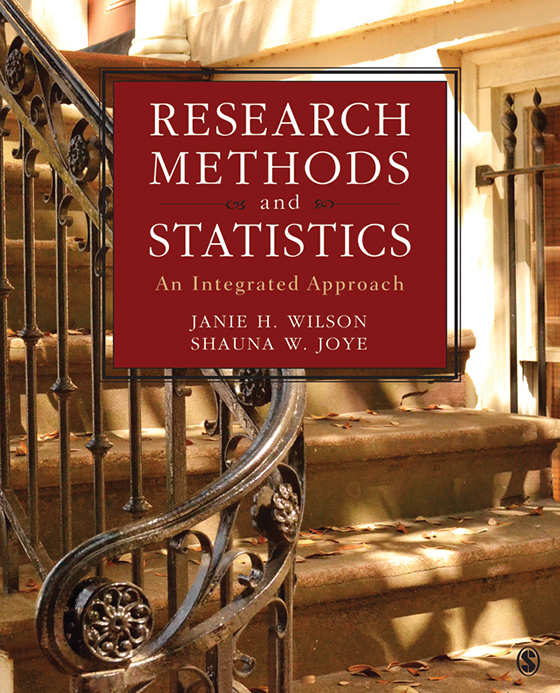

Research Methods and Statistics
An Integrated Approach
July 2016 | 488 pages | Sage US
| Format | Published Date | ISBN | Price |
|---|
This innovative text offers a completely integrated approach to teaching research methods and statistics by presenting a research question accompanied by the appropriate methods and statistical procedures needed to address it. Research questions and designs become more complex as chapters progress, building on simpler questions to reinforce student learning. Using a conversational style and research examples from published works, this comprehensive book walks readers through the entire research process and includes ample pedagogical support for SPSS, Excel, and APA style.
Table Of Contents:
- Preface
- Acknowledgments
- About the Authors
- Section I- Foundations of Design and Analysis
- Chapter 1- The Scientific Method
- Empirical Data
- Step 1: Ask a Question
- Choose a Topic
- Ask a Simple Question
- Step 2: Read the Published Literature
- Locate Research
- Choose a Specific Question
- Step 3: Create a Method
- Step 4: Collect and Analyze Data
- Step 5: Answer the Research Question
- Step 6: Share Your Results
- Research in Psychology: APA Style
- Summary
- Review of Terms
- Practice Items
- References
- Chapter 2- Ethical Research
- Ethical Treatment of Participants
- Assessing Risk to Participants
- Literature Review
- Hypothesis
- The Sample
- Method
- Statistics and the Data
- Benefits
- Risk
- Appendices
- Personnel
- Certification of Ethics Training
- Deception
- Testing of Special Populations
- Medical Procedures
- Animal Research
- Informed Consent
- Treating Participants Ethically
- Ethics After Testing Participants
- Data Entry
- Data Analysis
- Writing a Presentation or Manuscript
- Authorship Issues
- Presenting and Publishing Research
- Who Is Harmed by Unethical Behavior?
- Ethical Data-Collection Methods
- Summary
- Review of Terms
- Practice Items
- References
- Chapter 3- Research Designs and Variables
- Correlational Design
- Longitudinal Studies
- Cross-Sectional Studies
- Experimental Design
- Independent Variable
- Dependent Variable
- Cause and Effect
- Random Assignment
- Extraneous Variables
- Internal Validity
- Levels of Measurement
- Nominal Variable
- Ordinal Variable
- Interval Variable
- Ratio Variable
- Why Do We Care?
- Summarizing Variables: Central Tendency
- Mode
- Median
- Mean
- Summarizing Variables: Variability
- Range
- Standard Deviation
- SPSS: Summarizing Variables
- Nominal Data
- Ordinal Data
- Interval and Ratio Data
- Summary
- Review of Terms
- Practice Items
- Reference
- Chapter 4- Learning About a Population From a Sample
- Selecting a Sample
- Random Sampling
- Cluster Sampling
- Stratified Random Sampling
- Convenience Sampling
- Bias in a Sample
- Inferential Statistics
- Sampling Error
- Probability
- Hypothesis Testing
- Significance
- p-values and Effect Size
- Power and Sample Size
- Degrees of Freedom
- Summary
- Review of Terms
- Practice Items
- Section II- Categorical Variables and Simple Frequency
- Chapter 5- One Variable With Frequency Data
- Research Design: Categorizing Participants
- One-Way Chi Square With Equal Expected Frequencies
- SPSS: One-Way Chi Square With Equal Expected Frequencies
- Effect Size: Cohen’s w
- APA Style for the One-Way Chi Square With Equal Expected Frequencies
- Power
- One-Way Chi Square With Unequal Expected Frequencies
- SPSS: One-Way Chi Square With Unequal Expected Frequencies
- APA Style for the One-Way Chi Square With Unequal Expected Frequencies
- Summary
- Review of Terms
- Practice Items
- References
- Chapter 6- Two Variables With Frequency Data
- Research Design: Two Categorical Variables
- Two-Way Chi Square: 2 × 3 Design
- Power
- SPSS: 2 × 3 Chi Square
- Effect Size: Contingency Coefficient and Cramer’s V
- APA Style for the 2 × 3 Chi Square
- Two-Way Chi Square: 2 × 2 Design
- Effect Size: Phi Coefficient
- SPSS: 2 × 2 Chi Square
- APA Style for the 2 × 2 Chi Square
- Summary
- Review of Terms
- Practice Items
- References
- Section III- Research Without Grouping
- Chapter 7- Examining Relationships
- Pearson’s r: Seeking a Relationship
- SPSS: Pearson’s r (Seeking a Relationship)
- Two-Tailed Test
- One-Tailed Test
- Power
- Graphs as Figures: Scatterplot
- APA Style for Pearson’s r: Correlational Design
- Pearson’s r: Seeking Cause and Effect
- Previewing Data With a Scatterplot
- SPSS: Pearson’s r (Seeking Cause and Effect)
- Effect Size: Coefficient of Determination
- APA Style for Pearson’s r: Experimental Design
- Inaccurate Pearson’s r
- When Pearson’s r Falsely Shows No Relationship
- Outliers That Weaken Pearson’s r
- Nonlinear Relationship
- Restriction of Range
- When Pearson’s r Falsely Shows a Relationship
- Restriction of Range on a Curvilinear Relationship
- Outliers That Strengthen Pearson’s r
- Summary
- Review of Terms
- Practice Items
- References
- Chapter 8- Scale Development
- Pearson’s r and Reliability of Measures
- Test-Retest Reliability
- Alternate-Forms Reliability
- Split-Half Reliability
- Cronbach’s Alpha and Reliability of Measures
- SPSS: Scoring and Interpreting Measures
- Reverse Scoring Items
- Cronbach’s Alpha on SPSS
- Scoring a Measure
- Reliability With Subjective Measures: Interrater Reliability
- Pearson’s r and Validity
- Face Validity
- Content Validity
- Convergent Construct Validity
- Discriminant Construct Validity
- Predictive Validity
- Summary
- Review of Terms
- Practice Items
- References
- Chapter 9- Prediction
- Prediction and Correlation
- Linear Regression: Prediction Using One Predictor
- Correlation First
- Linear Regression
- Error in Predictions
- SPSS: Linear Regression
- Effect Size: Cohen’s f 2
- APA Style for Linear Regression
- Power
- Multiple Linear Regression: Prediction With Two Predictors
- SPSS: Multiple Linear Regression
- APA Style for Multiple Linear Regression
- Summary
- Review of Terms
- Practice Items
- References
- Section IV- Grouped Designs With Independent Samples
- Chapter 10- One Variable With Two Independent Groups
- Research Design: One IV With Two Levels
- SPSS: Independent-Samples t-test With an IV
- Directional Hypothesis
- Effect Size: Cohen’s d
- Confidence Intervals
- Power
- APA Style for the Independent-Samples t-test: Experimental Design
- Graphs as Figures: Bar Graph
- Outliers
- Using a Quasi-IV to Establish a Relationship
- SPSS: Independent-Samples t-test With a Quasi-IV
- APA Style for the Independent-Samples t-test: Correlational Design
- Summary
- Review of Terms
- Practice Items
- References
- Chapter 11- One Variable With More Than Two Independent Groups
- Research Design: One IV With More Than Two Levels
- SPSS: One-Way, Between-Groups ANOVA With an IV
- Effect Size: Eta Squared
- Post Hoc Comparisons
- Confidence Intervals
- Power
- APA Style for the One-Way, Between-Groups ANOVA: Experimental Design
- Analyzing a Quasi-IV With More Than Two Levels
- SPSS: One-Way, Between-Groups ANOVA With a Quasi-IV
- APA Style for the One-Way, Between-Groups ANOVA: Correlational Design
- Summary
- Review of Terms
- Practice Items
- References
- Section V- Grouped Designs With Related Samples
- Chapter 12- One Variable with Two Related Groups
- Testing the Same People Twice
- Problems With Testing the Same People Twice
- Practice Effect
- Fatigue Effect
- History Effect
- Maturation
- Solving Order Problems by Counterbalancing
- Avoiding Confounds
- Research Design: One IV With Two Related Groups
- SPSS: Related-Samples t-test (Experimental Design)
- Confidence Intervals
- Effect Size: Cohen’s d
- APA Style for the Related-Samples t-test: Experimental Design
- Power
- Research Design: One Quasi-IV With Two Related Groups
- SPSS: Related-Samples t-test (Correlational Design)
- APA Style for the Related-Samples t-test: Correlational Design
- Research Design: Testing Different People (Matched Pairs)
- Matching Participants
- Matching in a Two-Condition Study
- The Matching Process
- SPSS: Matched-Pairs t-test
- APA Style for the Matched-Pairs t-test
- Summary
- Review of Terms
- Practice Items
- References
- Chapter 13- One Variable With Repeated Measures: More Than Two Groups
- Research Design: One IV With Repeated Measures
- SPSS: One-Way, Repeated-Measures ANOVA (Experimental Design)
- Sphericity
- Effect Size: Eta Squared
- Confidence Intervals
- Power
- APA Style for the One-Way, Repeated-Measures ANOVA: Experimental Design
- Research Design: One Quasi-IV With Repeated Measures
- SPSS: One-Way, Repeated-Measures ANOVA (Correlational Design)
- APA Style for the One-Way, Repeated-Measures ANOVA: Correlational Design
- Summary
- Review of Terms
- Practice Items
- References
- Section VI- Advanced Design
- Chapter 14- Two Variables With Independent Samples
- Research Design: Two IVs With Independent Samples
- SPSS: Two-Way, Between-Groups ANOVA (No Significant Interaction)
- Effect Size: Eta Squared
- Post Hoc for a Main Effect
- Confidence Intervals
- Power
- Graphing a Main Effect
- APA Style for Two-Way, Between-Groups ANOVA With Main Effects
- Research Design: One IV and One Quasi-IV With Independent Groups
- SPSS: Two-Way, Between-Groups ANOVA (Significant Interaction)
- Examining the Interaction
- Post Hoc for an Interaction
- Graphing an Interaction
- APA Style for the Two-Way, Between-Groups ANOVA With an Interaction
- Summary
- Review of Terms
- Practice Items
- References
- Appendices
- Appendix A- Power Analysis Table
- Appendix B- Graphing in Excel
- Scatterplots
- Bar Graphs
- Line Graphs
- Interaction Graphs
- Appendix C- APA-Style Manuscript Guidelines
- Key Elements in APA-Style Writing
- The Basics
- Title Page
- Abstract
- Introduction
- Method
- Results
- Discussion
- References
- Tables, Figures, and Appendices
- Common Mistakes and Tips for Writing
- Example Paper With Comments
- Example Paper Without Comments
- Appendix D- Selected Answers to Practice Items
- Appendix E- Glossary of Terms
- Index